ROMAN ANTIQUITIES / NUMISMATIC IDENTIFICATION GUIDE
Reading the History Hidden on Roman Coins
Learn how to interpret emperor portraits, Latin inscriptions, reverse designs, mint marks, and other clues found on ancient Roman currency.
An ancient Roman coin may be small enough to fit comfortably in the palm of your hand, yet its surface can preserve an extraordinary amount of historical information.
A portrait might identify an emperor who ruled nearly two thousand years ago.
A short Latin inscription may reveal a ruler’s titles, political authority, or family connections.
Figures on the reverse can represent Roman gods, military victories, prosperity, or messages intended to reinforce imperial power.
Some coins also contain marks identifying the mint or workshop where they were produced.
These details make Roman coins valuable historical sources.
For collectors, students, and museum visitors, learning to interpret them is an introduction to numismatics, the study of coins, currency, and related objects.
This guide explains how to examine a Roman coin systematically, even when its inscriptions are abbreviated or its surface is worn.
Start by Identifying the Two Sides
Most Roman coins have two principal sides.
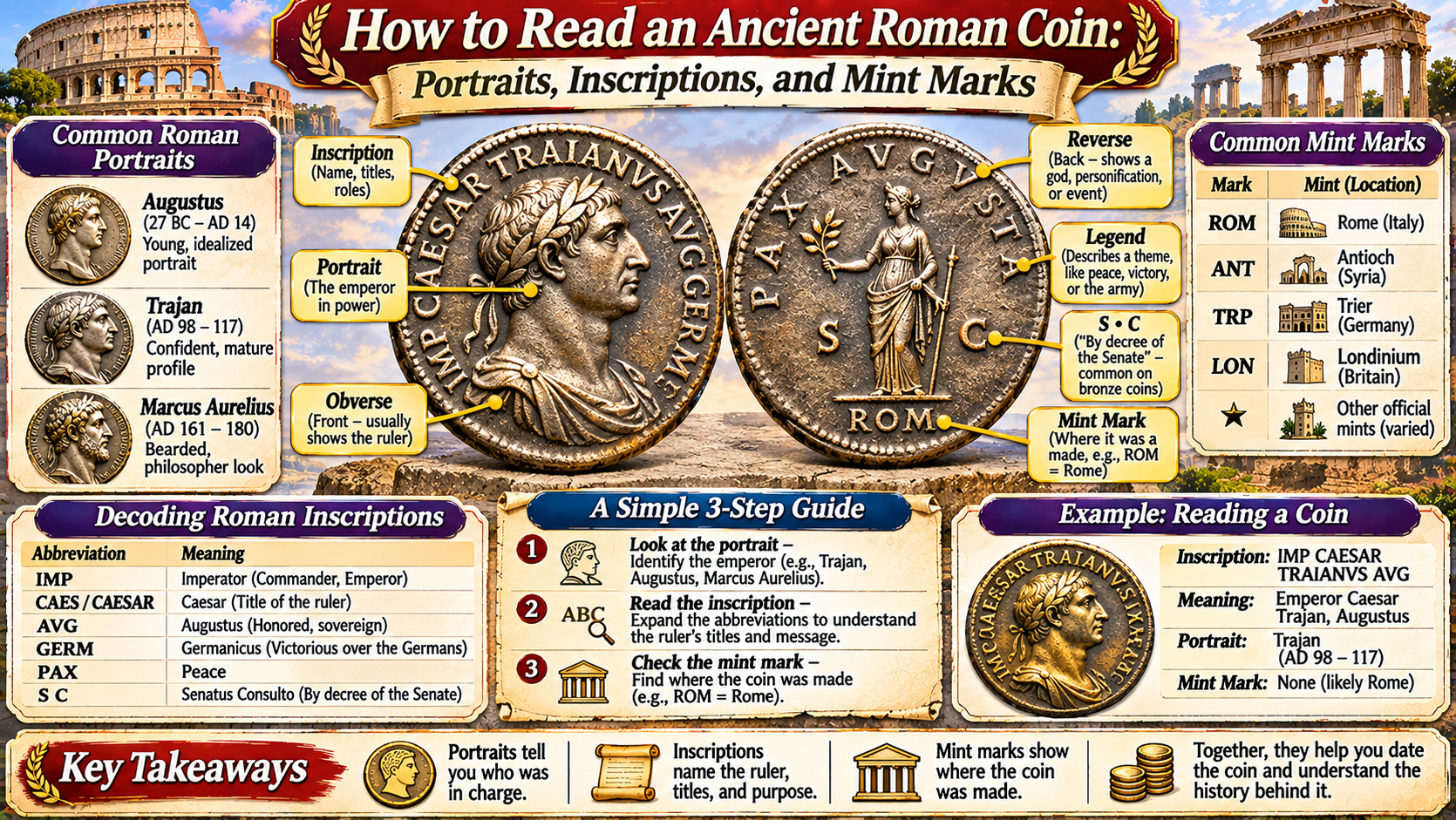
The obverse is commonly considered the front of the coin.
On many imperial Roman issues, it displays a portrait of the emperor or another member of the imperial family.
The reverse is the opposite side.
It may contain a deity, personification, military scene, building, animal, or symbolic object.
Both sides can include inscriptions.
On imperial coins, the obverse legend often identifies the person portrayed, while the reverse communicates additional political or religious themes.
However, Roman coin designs changed over time, and not every coin follows the same arrangement.
COIN SIDE 01
Obverse
Often features an imperial portrait and an inscription identifying the ruler or another prominent person.
COIN SIDE 02
Reverse
Often presents religious, political, military, or civic imagery accompanied by a legend or identifying marks.
Reading the Portrait
Portraits are among the most recognizable features of Roman imperial coins.
They can help identify emperors, empresses, and other members of the ruling family.
Look closely at the hairstyle, facial features, headwear, and direction the portrait faces.
Some emperors are depicted wearing a laurel wreath.
Others appear with a radiate crown, military helmet, or elaborate ceremonial headwear.
These details can offer clues about the coin’s period or denomination.
For example, the radiate crown became associated with certain imperial coin types, including the antoninianus.
However, portrait features alone are not always sufficient for identification.
Artistic styles varied between mints and periods, and many rulers were depicted using similar conventions.
The surrounding inscription is often more reliable than facial resemblance.
Understanding Latin Coin Inscriptions
Roman coin inscriptions are often called legends.
They usually contain abbreviated Latin words and titles.
Space was limited, so engravers frequently shortened names and official designations.
A beginner may initially see a confusing series of capital letters.
Once common abbreviations become familiar, however, many inscriptions become easier to interpret.
One frequently encountered abbreviation is IMP, representing Imperator.
Another is AVG, representing Augustus, an imperial title.
CAES or CAESAR may also appear as part of an imperial name or title.
These terms should be interpreted in historical context because Roman titulature evolved over time.
Common Roman Coin Abbreviations
| Abbreviation | Latin Meaning | General Interpretation |
|---|---|---|
| IMP | Imperator | Imperial or military title |
| AVG | Augustus | Imperial title |
| CAES | Caesar | Imperial name or title |
| P M | Pontifex Maximus | Chief priestly title |
| TR P | Tribunicia Potestas | Tribunician power |
| COS | Consul | Consular office or count |
| P P | Pater Patriae | Father of the Fatherland |
Not every Roman coin contains these abbreviations.
Some coins have only a short legend, while others contain lengthy sequences of titles.
Reading the complete inscription is usually more useful than identifying a single abbreviation in isolation.
How Inscriptions Can Help Date a Coin
Some Roman coin legends contain information that helps establish a date or narrower chronological range.
Consular titles may include numerals indicating how many times an emperor held the consulship.
Tribunician power could also be numbered and renewed, providing useful chronological evidence.
For example, a legend containing COS III indicates a third consulship.
However, this does not automatically identify a single year without additional historical information.
Researchers compare titulature with documented imperial careers and established coin catalogues.
Portrait styles, reverse types, and mint information can further refine an attribution.
Many coins can be dated only to a range of years rather than an exact production date.
What the Reverse Design Tells You
The reverse of a Roman coin often communicates a message.
Some designs celebrate military victories or territorial achievements.
Others emphasize peace, security, prosperity, religious devotion, or the emperor’s relationship with the Roman people.
Roman deities and personifications frequently appear on reverse designs.
Victoria, the personification of victory, may be depicted with wings.
Pax represents peace, while Felicitas is associated with happiness or good fortune.
Figures can hold objects such as wreaths, cornucopias, shields, or scepters.
These attributes help identify the subject.
Nevertheless, similar figures can appear in different contexts, so the reverse inscription remains important.
NUMISMATIC NOTE / REVERSE SYMBOLISM
Roman Coins Were More Than Everyday Money.
Their images and inscriptions could communicate messages about authority, religion, military success, and imperial identity across the Roman world.
What Is a Mint Mark?
A mint mark is a letter, abbreviation, or symbol that helps identify where a coin was produced.
Mint marks became especially important on many later Roman imperial coins.
They are often found in the exergue, the area beneath the main reverse design, although marks can also appear elsewhere.
Some late Roman mint marks contain abbreviations associated with particular cities.
For example, marks containing ROM may identify Rome, while CON can be associated with Constantinople in appropriate contexts.
Other letters or symbols may identify individual workshops, called officinae.
Interpreting these marks requires care because abbreviations and mint systems changed over time.
Not every Roman coin has a recognizable mint mark, and a few visible letters may not be enough for a secure identification.
Where to Look for Mint Marks
Begin by examining the lower portion of the reverse.
Look beneath any horizontal line separating the main image from the bottom inscription area.
This lower space is commonly called the exergue.
On many late Roman bronze coins, the exergue contains a sequence of letters identifying a mint and sometimes a workshop.
Additional field marks may appear beside the central figure.
These marks can distinguish different issues that otherwise look similar.
A magnifying glass and good lighting can help reveal details obscured by wear or corrosion.
How Metal and Size Help Identification
Roman coins were produced in gold, silver, bronze, and copper-alloy compositions.
Metal, diameter, and weight can provide useful identification clues.
For example, a silver denarius differs from a gold aureus in both material and monetary context.
However, Roman coinage changed substantially over the centuries.
Coin names, metal content, and standards were not constant throughout Roman history.
Later Roman coinage included reforms that introduced new denominations and altered existing systems.
Therefore, physical measurements should be compared with examples from the appropriate period.
Appearance alone may also be misleading because corrosion, wear, and surface treatments can change how a coin looks.
A Practical Method for Reading a Roman Coin
COIN STUDY DESK / IDENTIFICATION SEQUENCE
Identify the obverse and reverse, noting the main portrait and imagery.
Record visible letters and identify possible names or imperial titles.
Look for deities, personifications, buildings, animals, and symbolic objects.
Inspect the exergue and surrounding fields for letters or workshop symbols.
Use reliable museum collections or numismatic catalogues to confirm the identification.
Why Roman Coins Sometimes Look Different
Two coins issued under the same emperor may have different portraits, inscriptions, or reverse designs.
They may belong to different denominations or have been produced at different mints.
Changes in political circumstances could also influence coin imagery.
Some emperors issued coins celebrating military achievements, while others emphasized dynastic legitimacy or religious themes.
Production methods could introduce additional variation.
Roman coins were commonly struck using engraved dies, and individual dies could differ slightly.
Wear and corrosion can further alter the appearance of surviving examples.
These variations make careful comparison important.
How to Handle an Ancient Coin Safely
Ancient coins can be fragile, particularly when their surfaces have been affected by corrosion.
Handle coins carefully and avoid unnecessary rubbing.
Do not use abrasive cleaners or household chemicals on an unidentified coin.
Aggressive cleaning can remove historical surface details and reduce research value.
For examination, place the coin on a soft, stable surface under good lighting.
Photograph both sides and record measurements when appropriate.
If the coin is potentially significant, seek advice from a qualified numismatist or conservator before attempting treatment.
Frequently Asked Questions
How can I identify an ancient Roman coin?
Start with the portrait and inscriptions, then examine the reverse design, mint marks, metal, size, and weight.
What does AVG mean on a Roman coin?
AVG is an abbreviation for Augustus, an important Roman imperial title.
What does IMP mean on Roman coins?
IMP represents Imperator, a title associated with military command and imperial authority.
Where are Roman mint marks located?
On many later Roman coins, mint marks appear in the exergue beneath the reverse design, although other placements also occur.
Do all Roman coins show emperors?
No. Roman coinage includes Republican issues, imperial family portraits, deities, personifications, and many other subjects.
Can a Roman coin be identified without a readable inscription?
Sometimes. Portrait style, reverse imagery, measurements, and comparison with known examples may support an identification.
Should I clean an ancient Roman coin?
Avoid aggressive cleaning. Improper treatment can damage surfaces and remove valuable historical details.
Final Thoughts
Ancient Roman coins are miniature historical documents.
Their portraits identify rulers and important individuals.
Latin inscriptions preserve official titles and political messages.
Reverse designs reveal religious imagery, military achievements, and imperial ideals.
Mint marks can provide clues about where particular coins were produced.
By examining these features together, beginners can move beyond simply recognizing a Roman coin and begin understanding the historical information it contains.
Even a worn coin may preserve valuable evidence about the society that created it.


