THE MINT & MONEY MUSEUM · EVERYDAY DESIGN HISTORY
The Small Details That Help Protect and Identify Our Coins
Explore why some coins have ridged edges, how the design developed, and why modern money uses different textures, shapes, and security features.
Take a coin from your pocket and run a finger around its edge.
You may notice a series of small grooves, a completely smooth surface, or even lettering pressed into the metal.
These differences are easy to overlook because most people focus on the images and numbers printed on the faces of coins.
However, the edges of coins have an important history.
For centuries, governments and mints have used edge designs to discourage tampering, distinguish denominations, and improve the practical handling of money.
Ridged edges are especially familiar on coins such as the United States dime and quarter.
But why were these grooves introduced in the first place?
The original importance of ridged coin edges was closely connected to protecting precious-metal coins against the removal of small amounts of valuable metal.
Today, the same design feature continues to serve practical and recognizable purposes, even though most circulating coins no longer contain significant amounts of silver or gold.
What Are Ridged Coin Edges Called?
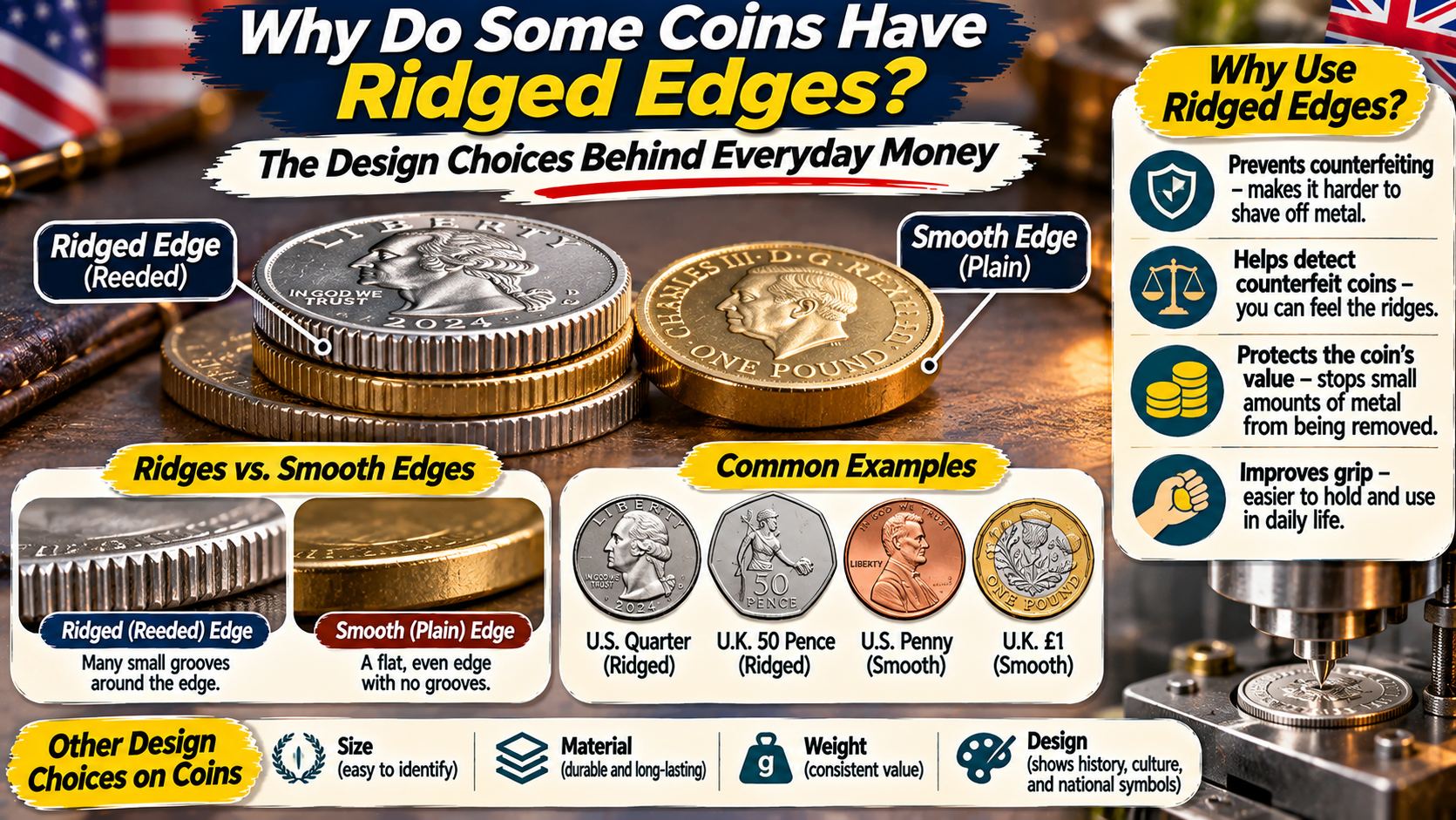
The small, regularly spaced grooves around the edge of a coin are commonly known as reeding.
A coin with this feature is described as having a reeded edge.
Reeding creates a repeating pattern of narrow raised sections and grooves around the coin’s circumference.
Not every coin uses this design.
Some have plain edges, while others feature lettering, symbols, or alternating textured and smooth sections.
The edge design is a deliberate part of the coin’s specifications.
It may be selected for historical reasons, denomination recognition, manufacturing requirements, or security-related considerations.
Understanding why reeding became common requires looking back to a period when coins were made from precious metals.
The Historical Problem of Coin Clipping
In earlier monetary systems, many coins contained substantial amounts of silver or gold.
The metal itself represented an important part of the coin’s value.
This created an opportunity for dishonest individuals.
A person could remove a small amount of precious metal from the edge of a coin while attempting to leave the main design recognizable.
This practice was known as coin clipping.
If enough metal was removed, the coin could become noticeably lighter than its intended weight.
The removed silver or gold could potentially be collected and sold or used elsewhere.
Coin clipping was a serious concern in monetary systems where coins circulated according to their precious-metal content.
Governments therefore sought methods to make unauthorized metal removal easier to detect.
One important development was the use of more consistent machine-struck coins with carefully finished edges.
NUMISMATIC HISTORY / SECURITY DESIGN
A Regular Edge Pattern Made Missing Metal Easier to Notice.
If someone shaved or clipped the edge of a reeded coin, the original pattern could be damaged or removed, providing a visible indication of possible tampering.
How Ridged Edges Helped Prevent Coin Clipping
A smooth-edged precious-metal coin could be difficult to inspect if only a small amount of metal had been removed.
Reeding made this kind of tampering more apparent.
The repeated grooves created a recognizable pattern around the coin.
Removing metal from the edge could disturb that pattern.
A person examining the coin might notice an unusually smooth section, irregular grooves, or other signs of damage.
Reeding did not make clipping physically impossible.
However, it increased the likelihood that tampering would be detected.
This made edge design a useful part of coin security.
Other improvements, including more precise minting and standardized weights, also helped strengthen confidence in circulating coins.
The Rise of Machine-Minted Coins
Early coins were often struck by hand using metal blanks and engraved dies.
Hand production could result in variations in shape, thickness, and edge appearance.
As minting technology developed, mechanical presses made it possible to produce more uniform coins.
Improved machinery helped standardize coin dimensions and designs.
Edge treatments became an increasingly important part of the production process.
During the early modern period, European mints adopted technologies that could produce more consistent edges.
These included lettering and patterned edges intended to discourage clipping.
As industrial minting expanded, edge designs became easier to reproduce accurately on large numbers of coins.
Modern mints continue to use specialized equipment to produce precise and repeatable edge features.
How Modern Mints Create Ridged Edges
Modern coins are generally produced from prepared metal blanks using high-pressure minting equipment.
The exact process depends on the coin’s design and the machinery used.
For many reeded coins, the edge pattern is formed during striking.
A retaining component called a collar surrounds the coin blank while the dies strike its faces.
If the collar has the appropriate internal pattern, the metal can be pressed into that pattern during striking.
This creates the grooves around the coin’s edge.
Other edge features may be applied through separate manufacturing steps.
For example, some lettered-edge coins require specialized equipment or additional operations.
Modern production methods allow mints to control dimensions, weight, and surface details with considerable precision.
MINTING WORKSHOP / SIMPLIFIED PROCESS
A prepared blank is made to the required size and composition.
The blank is positioned between the coin dies and within the retaining collar.
High pressure forms the designs on the coin’s faces and, for suitable designs, the reeded edge.
Finished coins undergo quality checks before entering the monetary system.
Why Some Modern Coins Still Have Reeding
Most modern circulating coins are not made primarily from precious metals.
For example, current circulating US dimes and quarters use copper-nickel clad construction rather than the silver compositions used historically.
This means the original concern about removing valuable silver from everyday coins is no longer the main reason for their reeded edges.
Nevertheless, reeding remains useful.
It provides a familiar physical characteristic associated with certain denominations.
It can help people distinguish coins through touch.
It also preserves a recognizable part of traditional coin design.
In some cases, different edge patterns contribute to the overall distinctiveness of a coin.
These features show how a design introduced for one historical purpose can continue to serve other functions.
Why US Dimes and Quarters Have Ridged Edges
In the United States, dimes and quarters are familiar examples of reeded-edge coins.
Historically, these denominations were produced with substantial silver content.
Reeded edges helped reveal attempts to remove precious metal.
Although their metal composition later changed, the edge design remained.
By contrast, the modern US cent and nickel have plain edges.
These differences also make the coins easier to distinguish by touch.
However, edge texture should be considered alongside coin size, thickness, and other identifying features.
US coin designs have changed over time, so historical and special-issue coins may have different characteristics from current everyday circulation coins.
How British Coins Use Different Edge Designs
British coinage also demonstrates how edge treatments can vary between denominations.
Some coins have milled or reeded edges, while others have plain or lettered edges.
The current UK £1 coin is particularly distinctive because of its twelve-sided shape and other security features.
Its edge design includes alternating milled and plain sections.
The £2 coin uses edge lettering on many circulating designs, although the wording can vary between issues.
These features contribute to the physical identity of the coins.
They also demonstrate that modern mints use several design approaches rather than relying exclusively on reeding.
Coin specifications can change, so collectors and researchers should consult official mint information when examining a particular year or issue.
Reeded, Plain, and Lettered Edges Compared
| Edge Type | Appearance | Common Purpose | Example |
|---|---|---|---|
| Reeded | Regular grooves around the edge | Historical tamper detection and denomination recognition | US quarter |
| Plain | Smooth edge | Simple construction and denomination design | US cent |
| Lettered | Words or symbols on the edge | Identification, decoration, or security-related design | Many UK £2 coins |
| Alternating | Textured and plain sections | Distinctive physical design | UK £1 coin |
How Coin Edges Help with Accessibility
Physical differences between coins can help people identify denominations without relying entirely on visual details.
Edge texture is one useful characteristic.
A reeded coin feels different from a smooth-edged coin.
Coins may also vary in diameter, thickness, weight, and shape.
These combined features can support tactile identification for people with visual impairments.
However, edge texture alone is not always sufficient to distinguish every denomination reliably.
Effective accessible currency design considers several physical characteristics together.
This is one reason the overall design of a coin matters beyond its decorative appearance.
Are Ridged Edges Still a Security Feature?
Reeded edges can contribute to a coin’s recognizable design, but modern coin security involves many additional features.
Depending on the denomination, these may include specialized metal compositions, precise dimensions, distinctive shapes, and complex surface designs.
Some coins also incorporate features intended to make counterfeiting more difficult.
Modern coin authentication may depend on physical and electromagnetic properties rather than edge appearance alone.
For this reason, reeding should not be viewed as a complete anti-counterfeiting system.
It is one element within the broader design and manufacturing specifications of a coin.
Why Coin Edges Matter to Collectors
Coin collectors, also called numismatists, often examine edge details when studying coins.
The edge can provide information about a coin’s type, production method, and condition.
Unusual edge characteristics may indicate wear, damage, manufacturing variation, or possible alteration.
Some collectible coins have special edge lettering or patterns.
However, not every unusual-looking edge represents a valuable mint error.
Normal circulation damage can create irregularities that resemble manufacturing mistakes.
Collectors therefore compare suspected errors with reliable references and established coin specifications.
Professional authentication may be appropriate for potentially significant coins.
Other Design Choices Behind Everyday Money
Coin edges are only one part of a larger design system.
Governments and mints must consider how coins will be produced, recognized, handled, and circulated.
Size and weight help distinguish denominations.
Metal composition influences durability, manufacturing cost, and compatibility with coin-processing equipment.
Shape can provide another recognizable feature.
Images, numbers, lettering, and national symbols communicate value and identity.
Durability is especially important because circulating coins may remain in use for many years.
A successful coin design balances practical function, manufacturing efficiency, accessibility, and public recognition.
A Simple Activity: Compare Coins from Different Countries
Examining a few everyday coins can reveal how much design variation exists.
Choose several coins from different denominations or countries.
Look closely at their edges under good lighting.
Notice whether the edges are smooth, reeded, lettered, or patterned.
Compare their size, thickness, weight, and shape.
Then consider how easily you could distinguish the coins without looking at their faces.
This simple activity demonstrates the practical importance of coin design.
It also provides an introduction to the history and technology of money.
Frequently Asked Questions
Why do some coins have ridged edges?
Ridged edges were historically useful for revealing attempts to remove precious metal from coins. Today, they also contribute to denomination recognition and familiar coin design.
What are the ridges on coins called?
The grooves around a coin’s edge are called reeding, and a coin with this pattern has a reeded edge.
Why do US quarters have ridged edges?
US quarters historically contained silver, and reeded edges helped make metal removal more noticeable. The design remained after circulating quarters changed to a different metal composition.
Why are some coins smooth around the edges?
Plain edges are a deliberate design choice. Their use depends on the denomination, historical practices, manufacturing specifications, and other design considerations.
Do ridged edges prevent counterfeiting?
They can contribute to a coin’s distinctive design, but modern anti-counterfeiting measures involve additional physical and manufacturing features.
How are ridged edges made?
For many coins, reeding is formed during striking when metal is pressed against a patterned collar inside the minting press.
Why do some coins have writing on their edges?
Edge lettering can provide identification, decoration, historical meaning, or security-related design features, depending on the coin.
Final Thoughts
Ridged coin edges are a small feature with a surprisingly important history.
They developed in connection with the need to protect precious-metal coins from clipping and other forms of tampering.
As minting technology improved, more consistent edge patterns became possible.
Although most everyday circulating coins no longer contain substantial amounts of silver or gold, reeding remains a familiar design feature.
It can help distinguish denominations, support tactile recognition, and preserve established coin traditions.
Other coins use plain edges, lettering, unusual shapes, or combinations of these features.
Each choice reflects a balance between history, manufacturing, security, and everyday usability.
The next time you hold a coin, examine its edge as carefully as its faces.
Those small grooves may tell a story that reaches back centuries into the history of money.