Twenty-First Century Minting Physics: High-Tech Numismatic Art
Modern commemorative minting has evolved from traditional precious metal stamping into a high-technology frontier where nanotechnology, laser physics, and advanced metallurgy converge.
From bimetallic molecular bonding under 150-ton hydraulic pressures to micro-laser holographic latent images, colorized pad printing, and frosted cameo proof contrast, this comprehensive analysis explores the cutting-edge engineering shaping contemporary world coinage.
🪙
Part I: Bimetallic Bonding
The Engineering of Bimetallic and Trimetallic Coinage
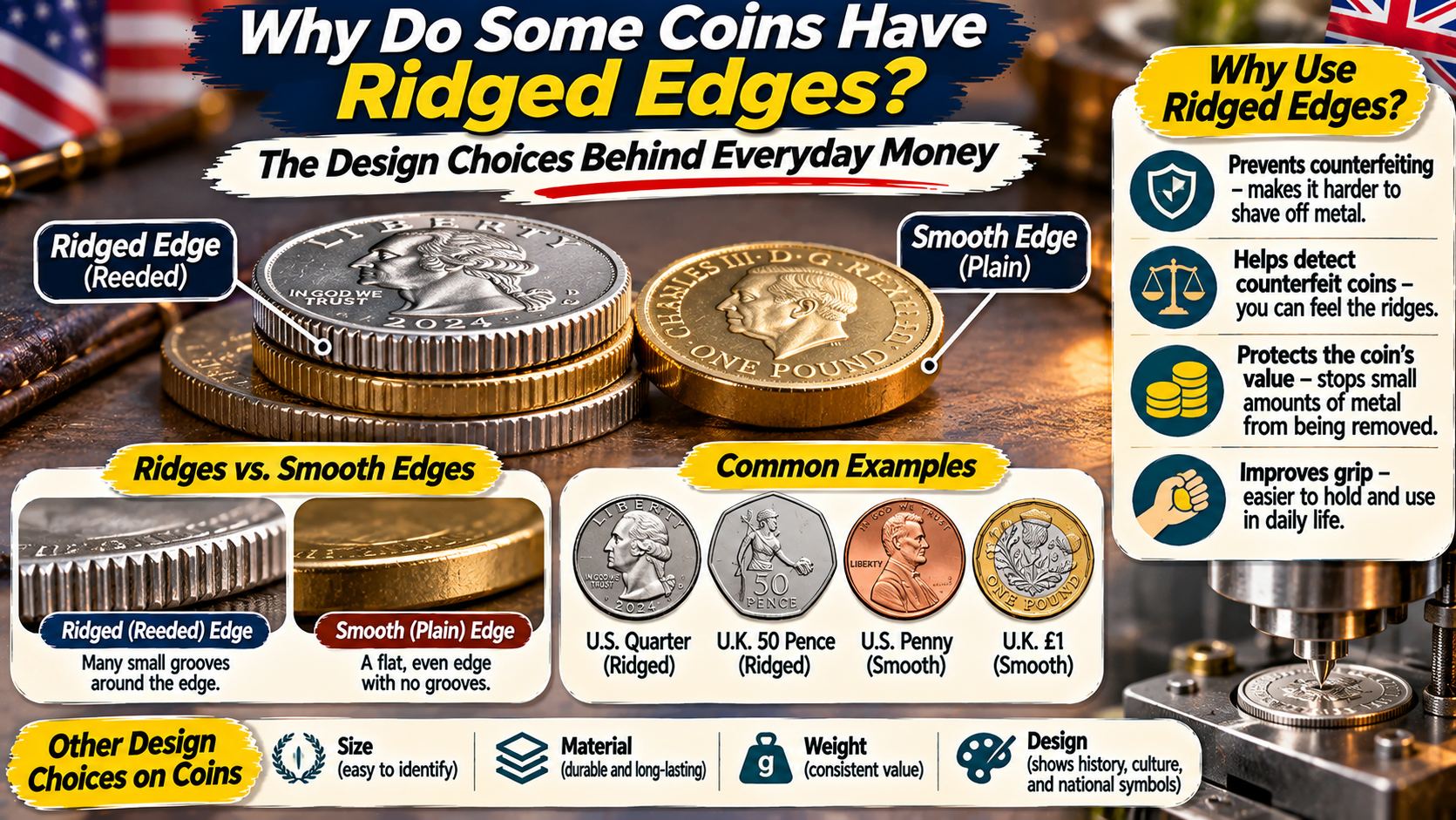
One of the most radical structural departures in modern circulating and commemorative coinage is the widespread adoption of bimetallic (and trimetallic) architecture. Pioneered for circulating currency by the Italian State Mint (Istituto Poligrafico e Zecca dello Stato) in 1982 with the celebrated 500-lire coin, bimetallic coinage consists of an outer metallic ring and a distinct central inner core made of contrasting alloys. Today, bimetallic coins are ubiquitous across global commerce, exemplified by the British £1 and £2 coins, the Euro €1 and €2 coins, the Canadian $2 ‘Toonie’, and the Mexican 10-peso coin.
Manufacturing a bimetallic coin requires extraordinary mechanical precision. The outer ring is punched from a metallic strip (such as nickel-brass or stainless steel) and pierced with a precision circular central hole. Concurrently, a separate inner core slug is punched from a contrasting alloy (such as cupronickel or copper-aluminum). The inner core must possess an exact outer diameter matching the inner diameter of the ring within a tolerance of less than 0.02 millimeters. The interior rim of the outer ring is grooved with an interlocking dovetail trench or microscopic teeth.
Inside the high-speed coining press, a specialized automated feeding arm drops the outer ring and inner core into the collar die simultaneously as separate, unjoined components. When the upper hammer die strikes the assembled pieces with eighty to one hundred and fifty tons of compressive pressure, the extreme plastic deformation forces the metals to expand radially: the soft inner core mushrooms laterally, locking its edges permanently into the dovetail groove of the outer ring with molecular-level mechanical grip. Once struck, the two metals are inseparable—even heavy sledgehammer impacts or thermal freezing cycles cannot dislodge the central core without destroying the coin entirely.
| Minting Technology | Primary Engineering Mechanism | Visual / Optical Effect | Security / Collector Benefit | Leading Global Mint Pioneers |
|---|---|---|---|---|
| Bimetallic Assembly | Mechanical dovetail interlocking under 150-ton strike force | Contrasting two-tone metallic rings (e.g., gold core, silver ring) | Prevents automated vending machine slugs; high visual contrast | Monnaie de Paris, Royal Mint (UK), Royal Canadian Mint |
| Laser Latent Images | Micro-groove laser ablation angled at differing optical planes | Image shifts dynamically (e.g., numeral changes to national crest) | High-security anti-counterfeiting; instant public optical verification | Royal Canadian Mint, Spanish Royal Mint (FNMT) |
| Colorized PAD Printing | Silicone pad transfer of elastomeric UV-cured inks | Vibrant photographic colors directly bonded to metallic relief | Artistic commemorative themes; pop culture & floral motifs | Perth Mint (Australia), New Zealand Post, Monnaie de Paris |
| Ultra-Camero Proof | Acid/laser micro-frosting on devices; mirror polished fields | Deep, black-mirror fields with dazzling frosted white cameos | Supreme aesthetic standard for numismatic collector coins | US Mint (West Point), British Royal Mint, Austrian Mint |
| Selective Gold Plating | Electrolytic immersion masking or chemical vapor deposition | High-karat gold selectively highlighting central device on silver | Luxury contrasting finish; commemorative regal elegance | Royal Canadian Mint, Royal Australian Mint |
| Smartminting (CIT) | Proprietary multi-strike high-relief hydraulic deformation | Colossal sculptural relief heights up to 4x standard coins | Sculptural fine-art medals; micro-detail preservation | Coin Invest Trust (CIT), B.H. Mayer Mint (Germany) |
⚖️
Part II: Holographic Security
Holographic Latent Images: Nanotechnology and Laser Ablation
In the contemporary numismatic arena, holographic latent imagery represents the pinnacle of optical anti-counterfeiting and commemorative artistic flair. First popularized on high-grade bullion and circulating coins by the Spanish Royal Mint (Fábrica Nacional de Moneda y Timbre) and perfected by the Royal Canadian Mint on its celebrated Gold and Silver Maple Leaf bullion series, latent imagery creates dynamic, shifting visual devices directly within the solid metal of the coin.
To manufacture a latent image, mint engineers utilize high-energy industrial femtosecond laser ablation systems. Unlike traditional mechanical cutting tools that physically plow through metal, femtosecond lasers deliver ultra-short laser pulses lasting mere quadrillionths of a second. The laser vaporizes microscopic channels into the hardened steel die surface without transferring thermal heat to surrounding metal, carving microscopic saw-tooth diffraction gratings with sub-micron line spacing.
By angling the microscopic reflective facets of these micro-grooves in two distinct angular directions—typically 30 degrees to the left and 30 degrees to the right—the coin reflects ambient light selectively depending upon the viewer’s line of sight. When an observer holds the coin and tilts it slightly to the left, the microscopic facets catch the light and display an image of the denomination numeral (such as ’20’); when the coin is tilted to the right, those facets go dark and an alternate set of facets illuminates, displaying the sovereign state monogram or national flag. Because these micro-gratings are physically embossed into the solid metal under coining pressure, they cannot be scraped, peeled, or chemically removed.
🏛️
Part III: Colorized Coins
The Art and Chemistry of Colorized Planchets
During the late 1990s and early 2000s, the Royal Canadian Mint and the Perth Mint of Australia pioneered a revolutionary aesthetic frontier: the application of vibrant, photographic-quality color directly onto the metallic relief of commemorative coins. What began as an experimental novelty has matured into a sophisticated chemical and industrial discipline utilizing tampon printing (pad printing) and direct-to-metal ultraviolet (UV) inkjet deposition.
In modern pad printing installations, an etched silicone pad transfers highly specialized elastomeric ink from an engraved ink cup onto the complex, contoured surface of a struck coin. The silicone pad is pliable and deformable, allowing it to wrap smoothly over three-dimensional high-relief features—such as the delicate petals of a poppy flower, the plumage of a bird, or the enamel of a national flag—without smearing or distortion. The inks are formulated with advanced acrylic polymers and inorganic lightfast pigments that resist fading under sunlight.
Immediately following ink transfer, the coin passes beneath high-intensity ultraviolet curing lamps. The UV photons trigger instantaneous photochemical cross-linking within the ink matrix, curing the liquid resin into an indestructible, scratch-resistant enamel film in less than a second. Advanced modern installations employ CMYK multi-color printing stations capable of applying up to six distinct color separations with microscopic registration accuracy, enabling mints to reproduce fine art masterpieces, wildlife portraits, and vibrant heraldic enamels with photographic fidelity.
👑
Part IV: The Proof Finish
The Proof Standard: Deep Mirrors and Ultra-Cameo Frosting
For elite numismatic collectors, the undisputed gold standard of coin manufacturing is the Proof strike (PR or PF). Originally developed in sixteenth-century European mints as experimental presentation pieces struck to test new dies and demonstrate technical mastery to the sovereign monarch, modern proof coins are struck exclusively for collectors and museum archives, characterized by a dramatic, dazzling visual contrast between brilliant, mirror-like background fields and frosted, satiny relief devices (a visual quality known as Ultra-Cameo or Deep Cameo).
Achieving this breathtaking optical contrast requires an extraordinary, multi-step hand finishing ritual on the working dies. First, the entire working die—both the flat background field and the recessed design cavities—is polished to an absolute optical mirror finish by master engravers using progressively finer diamond-dust pastes and horsehair rotary brushes, culminating in diamond compounds down to 0.25 microns. At this stage, the die surface reflects light with flawless, distortion-free perfection.
Next, the polished die undergoes selective frosting. Using chemical masking resists or high-precision laser ablation, the flat background field is protected while the recessed design cavities are exposed to fine particulate glass-bead sandblasting or laser texturing. This micro-pits the interior surface of the design cavities with millions of microscopic light-scattering craters. When the die strikes a burnished, highly polished coin planchet in a cleanroom environment—delivered with multiple slow, heavy hydraulic presses—the smooth areas of the die produce glass-like reflective mirror fields on the coin, while the micro-pitted areas scatter light in all directions, producing brilliant, chalk-white frosted relief devices that appear to float majestically above a bottomless pool of black liquid metal.
📜
Part V: Extreme High Relief
Smartminting and the Future of Extreme Sculptural Relief
The most groundbreaking contemporary development in commemorative minting technology is the emergence of extreme high-relief minting, pioneered by Liechtenstein-based technology firm Coin Invest Trust (CIT) under their proprietary Smartminting technology (manufactured in partnership with B.H. Mayer Mint in Munich, Germany). For centuries, the height of coin relief was strictly limited by the physical mass of the planchet: to achieve high relief, mints had to double or triple the thickness of the coin, creating heavy, cost-prohibitive bullion pieces.
Smartminting shattered this physical limitation through advanced finite element simulation and computer-modeled plastic metal flow. By utilizing multi-stage hydraulic presses with custom-contoured die movements and specially pre-formed planchets, Smartminting enables coins to achieve unprecedented sculptural relief heights—up to four times the relief of traditional high-relief coins—while maintaining standard coin weights and diameters! Sculptures can feature dramatic, razor-sharp peaks, deeply undercut drapery folds, and microscopic edge textures that rival Renaissance bronze medals.
Looking into the future, modern commemorative minting stands at the exhilarating frontier of fine art, nanotechnology, and extreme manufacturing physics. Mints today are embedding certified space meteorites, ancient fossil fragments, and microscopic microchips directly into precious metal planchets, creating interactive physical-digital numismatic artifacts. As modern technology continues to push the boundaries of what is mechanically possible, the coin remains what it has been for twenty-six centuries: a timeless, indestructible physical canvas where human history, scientific mastery, and artistic vision unite.
Key Takeaways: Modern Commemorative Minting
Bimetallic Dovetail Locking: Outer rings and inner cores are molecularly bonded under 150-ton hydraulic strikes without adhesives or solder.
Laser Latent Micro-Images: Femtosecond lasers carve microscopic multi-angle diffraction gratings that shift between two distinct images as the coin is tilted.
UV-Cured Pad Printing: Silicone pads transfer vibrant elastomeric pigments over three-dimensional relief, cured instantly by ultraviolet radiation into durable enamel.
Ultra-Cameo Proof Contrast: Hand-polished diamond paste mirror fields paired with laser-frosted cameo devices create the supreme collector finish.
Curved and Domed Planchets: The Architecture of Concave-Convex Minting
In the realm of advanced commemorative minting engineering, one of the most stunning mechanical breakthroughs of the twenty-first century is the creation of curved, domed planchets. Traditionally, all coins struck in human history were flat planar discs. However, in 2009, the Monnaie de Paris stunned the numismatic world by striking the world’s first domed coin: the ‘Year of Astronomy’ commemorative, featuring a convex outer curve representing the celestial dome of the heavens and a concave inner bowl.
The United States Mint embraced this complex engineering challenge with extraordinary success in 2014 for the National Baseball Hall of Fame commemorative coins, and again in 2019 for the monumental Apollo 11 50th Anniversary commemorative series. The Apollo 11 coins featured a curved, domed architecture where the concave reverse perfectly replicated the famous curved visor of astronaut Buzz Aldrin’s Apollo spacesuit helmet, reflecting a mirror-image of Neil Armstrong, the American flag, and the lunar lander on the moon’s Sea of Tranquility, while the convex obverse formed the exterior curve of an astronaut’s footprint in lunar dust.
Striking a curved coin requires overcoming formidable metallurgical and physics barriers. The planchet blank must be pre-dished in specialized hydraulic dies before striking. During the high-pressure strike, the coining dies must descend along complex non-linear geometric axes: if the strike pressure is uneven by even a fraction of a percent, the curved metal will crumple like an aluminum can, or the dies will experience catastrophic shear fractures. The successful mass-production of hundreds of thousands of curved gold, silver, and clad coins demonstrates that the ancient craft of minting has transformed into an advanced aerospace-grade manufacturing science.
Furthermore, contemporary mints are experimenting with micro-engraved QR codes and cryptographic NFC chips embedded beneath transparent resin domes, allowing collectors to scan a physical gold coin with a smartphone to view blockchain-verified certificates of authenticity and 3D digital archival models. As physical commemorative minting embraces the digital frontier, it ensures that sovereign coins will continue to captivate collectors, celebrate historical milestones, and preserve the highest achievements of human art for generations to come.
The continuous boundary-pushing of modern commemorative coin technology proves that physical coinage is far from a dying medium. It remains an evolving, vibrant intersection of fine artistic sculpture, state sovereignty, national memory, and cutting-edge material science that will continue to inspire collectors for centuries.