Royal Masterpieces: Eleven Centuries of Sovereign Minting Art
Operating continuously since the year 886 CE under Alfred the Great, the Royal Mint of the United Kingdom has produced some of the most enduring, artistically sublime coin designs in human civilization.
At the zenith of this royal numismatic pantheon stands Benedetto Pistrucci’s 1817 neoclassical masterpiece—Saint George slaying the Dragon on the Gold Sovereign—alongside the rigorous traditions of royal coronation effigies, dynamic heraldry, and Matthew Boulton’s steam press revolution.
🪙
Part I: The 1816 Recoinage
The Great Recoinage of 1816 and the Rebirth of the Gold Sovereign
The modern era of British numismatic design was born out of the economic exhaustion that followed the Napoleonic Wars. For over two decades of titanic military struggle against revolutionary and imperial France, Britain had suffered from severe silver and gold shortages, forcing the Bank of England to suspend cash payments in 1797 and issue paper notes while counterstamping captured Spanish silver dollars to meet daily retail currency demand. With the final defeat of Napoleon at Waterloo in 1815, the British government under Lord Liverpool undertook the monumental Great Recoinage of 1816.
The Great Recoinage established the United Kingdom on the formal, de jure gold standard, declaring gold as the sole legal measure of value and reducing silver coins (crowns, half-crowns, shillings, and sixpences) to token status limited to small transactions. To serve as the flagship coin of the British Empire, the government revived the historic name of the Sovereign—a prestigious gold denomination originally created in 1489 under King Henry VII. Struck in 22-karat crown gold (91.67 percent pure gold, alloyed with 8.33 percent copper for durability), the new sovereign was defined as weighing exactly 7.988 grams (roughly 0.2354 troy ounces of pure gold), tariffed at exactly twenty shillings (one pound sterling).
To design the visual appearance of this supreme imperial coin, the Master of the Mint, William Wellesley-Pole (the older brother of the Duke of Wellington), took an audacious gamble: he bypassed traditional English heraldic engravers and commissioned an eccentric, volatile Italian gem-engraver who had recently arrived in London from Rome: Benedetto Pistrucci.
| Monarch & Reign | Master Sculptor / Engraver | Facing Direction | Iconic Portrait Style & Crown | Key Historic Coin Series |
|---|---|---|---|---|
| George III (1760 – 1820) | Benedetto Pistrucci | Facing Right | Classical Roman laureate bust; muscular neck | 1817 Sovereign; Crown of 1818 |
| Victoria (Young Head) | William Wyon | Facing Left | Neoclassical youthful profile; double hair fillet | 1838 – 1887 Sovereigns; Una and the Lion (1839) |
| Victoria (Jubilee / Old Head) | J.E. Boehm / Thomas Brock | Facing Left | Veiled widow’s headdress; imperial coronet | 1887 Jubilee series; 1893 Old Head coinage |
| George V (1910 – 1936) | Sir Edgar Bertram Mackennal | Facing Left | Dignified, unadorned truncated bare head with mustache | Wartime gold sovereigns; 1935 Silver Jubilee Crown |
| Elizabeth II (5 Portraits) | Gillick (1953), Machin (1968), Maklouf (1985), Rank-Broadley (1998), Clark (2015) | Facing Right | Evolution from youthful wreath to mature Tiara and Diadem | Decimal Day 1971; Gold Sovereigns & Britannias |
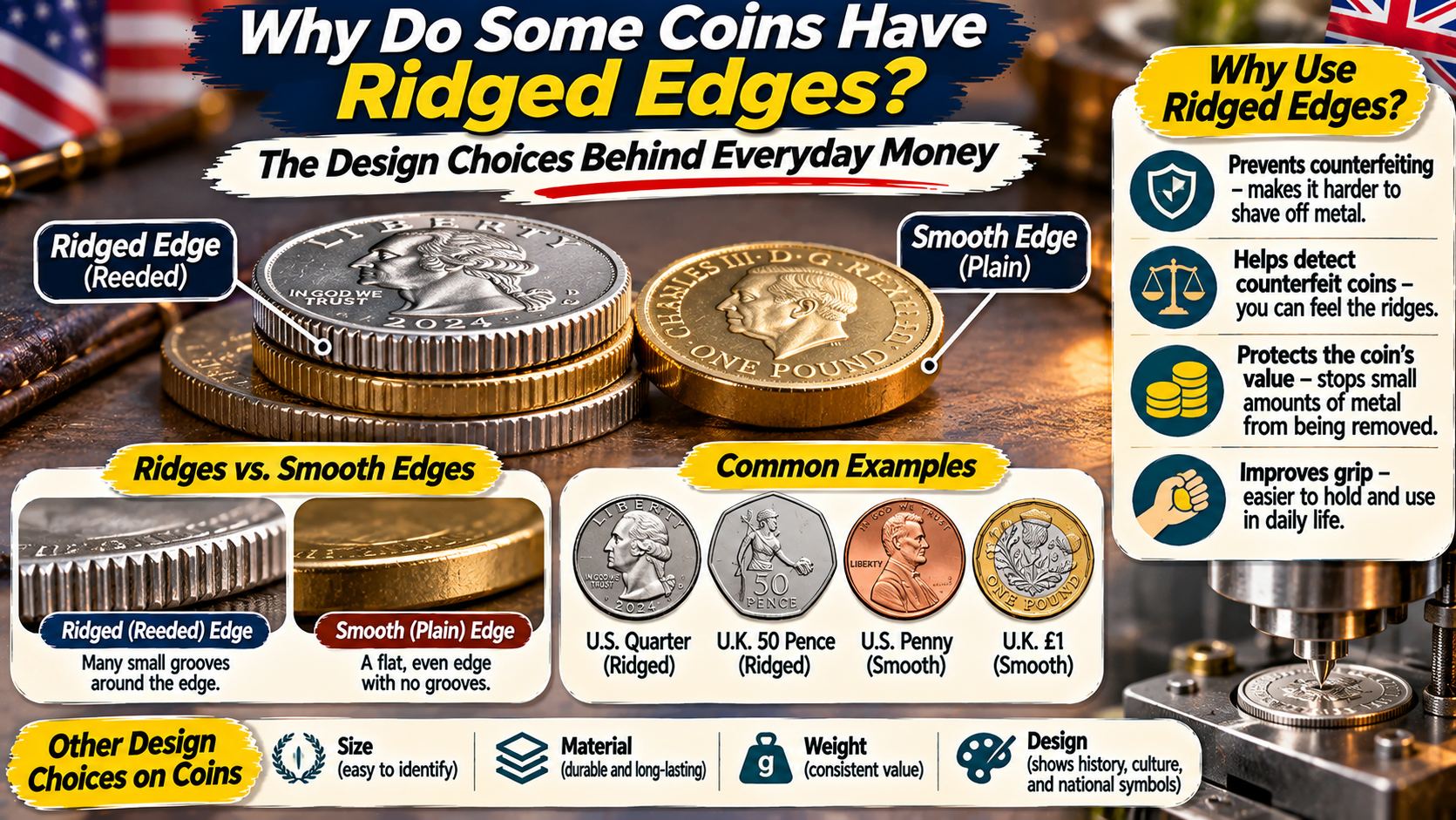
| Charles III (2022 – Present) | Martin Jennings | Facing Left | Bare-headed dignified naturalistic portrait; unadorned | Coronation Sovereigns; modern decimal circulation |
⚖️
Part II: Pistrucci’s Genius
Benedetto Pistrucci’s Masterpiece: Saint George Slaying the Dragon
Benedetto Pistrucci was already renowned across Europe as a virtuoso carver of cameo gemstones in hard chalcedony and jasper. When commissioned to create a reverse design for the new gold sovereign, Pistrucci flatly rejected the traditional, cluttered medieval royal coats of arms with their quarterly quarterings of Scottish lions, Irish harps, and French fleurs-de-lis. Instead, Pistrucci proposed a breathtaking neoclassical narrative drawn from English patronal legend: Saint George slaying the Dragon.
Pistrucci’s artistic execution broke completely with medieval gothic traditions. Instead of depicting Saint George as a medieval knight clanking in heavy steel plate armor, Pistrucci channeled the classical Greek Elgin Marbles (which had recently arrived in London from the Parthenon in Athens). Saint George is depicted as a heroic, nude classical warrior wearing only an arched helmet and floating cape, astride a muscular, rearing charger horse. The horse tramples the wounded, writhing mythical dragon under its hooves, while Saint George prepares to deliver the fatal coup de grâce with a short Roman gladius sword, having already broken his spear inside the beast’s neck.
The anatomical dynamism, muscular tension, and fluid classical harmony of Pistrucci’s Saint George and the Dragon astonished the public. Released on the gold sovereign in 1817 and the silver crown in 1818, the design was instantly hailed as the most magnificent coin reverse in modern history. The design was so universally beloved that it survived through the reigns of George IV, William IV, Queen Victoria, Edward VII, George V, George VI, Elizabeth II, and continues to be struck today under King Charles III—remaining the definitive, unbroken reverse emblem of the British Gold Sovereign for over two hundred years.
🏛️
Part III: Royal Facing Protocol
The Alternating Monarch Direction Rule: A Centuries-Old Royal Protocol
A fascinating, sacred unwritten protocol that governs British royal coinage is the tradition of alternating portrait directions. Every time a new monarch ascends the throne of the United Kingdom, their official coin portrait must face in the exact opposite direction of their predecessor. If a king faces right, his successor must face left, and the subsequent monarch must face right again. This unbroken tradition originated in 1660 following the restoration of King Charles II to the English throne.
During the preceding English Civil War and Commonwealth period (1649–1660), Dictator Oliver Cromwell had struck coinage with his portrait facing left. Following Cromwell’s death and the restoration of the Stuart monarchy, Charles II reportedly declared that he refused to look in the same direction as the traitorous regicide who had executed his father, ordering his coin portrait to face right. Whether fueled by royal vengeance or aesthetic contrast, every subsequent British monarch honored the pattern: James II faced left, William and Mary faced right, Queen Anne faced left, George I faced right, George II faced left, George III faced right, George IV faced left, William IV faced right, Queen Victoria faced left, Edward VII faced right, George V faced left, George VI faced left (due to Edward VIII’s crisis), Elizabeth II faced right, and modern King Charles III faces left.
The solitary disruption to this three-hundred-year rule occurred in 1936 with the brief, scandalous reign of King Edward VIII. Vain and iconoclastic, Edward VIII was supposed to face right to follow his father George V. However, Edward insisted that his left profile was significantly more handsome, as it showcased the stylish part in his hair. The King stubbornly ordered the Royal Mint to engrave his pattern coin dies facing left. When Edward abdicated in December 1936 before any circulating coins were released, his younger brother, King George VI, deliberately chose to face left on his coins, maintaining the protocol as if Edward VIII had faced right as tradition demanded.
👑
Part IV: William Wyon
William Wyon and the Masterpiece of ‘Una and the Lion’ (1839)
No historical exploration of British Royal Mint artistry can be complete without celebrating the legendary Chief Engraver William Wyon, who presided over the Victorian mint during the nineteenth century. Wyon’s supreme achievement arrived in 1839 with the creation of the celebrated five-pound gold proof piece known to collectors as ‘Una and the Lion’. Inspired by Edmund Spenser’s sixteenth-century epic poem The Faerie Queene, the coin was struck to celebrate the coronation of the young, nineteen-year-old Queen Victoria.
The reverse of the coin depicts Queen Victoria as the pure and virtuous maiden Una, guiding a colossal British lion with her royal scepter while pointing the way forward with an outstretched hand, accompanied by the Latin motto DIRIGE DEUS GRESSUS MEOS (‘May God Direct My Steps’). The sculptural elegance, tender maternal majesty, and breathtaking proof cameo finish of Una and the Lion established it as the undisputed holy grail of British numismatic art. Today, an authentic 1839 Una and the Lion in pristine proof condition commands between one million and three million dollars at international auctions, standing as the supreme aesthetic achievement of the Victorian Royal Mint.
Wyon was also responsible for the enduring ‘Young Head’ effigy of Queen Victoria that appeared on imperial coinage from 1838 until 1887. This neoclassical portrait was so beloved by the Queen and trusted across global trade markets in India, Canada, Australia, and South Africa that it circulated for nearly fifty years without alteration, long after Victoria had matured into a grandmother, before finally being replaced by the Jubilee Head in 1887.
📜
Part V: The Industrial Revolution
The Soho Mint Revolution: Matthew Boulton and Steam Power
While master engravers like Pistrucci and Wyon provided the artistic soul of British coinage, the modern manufacturing technology that made flawless coin mass-production possible was engineered by industrialist Matthew Boulton and his partner, steam engine inventor James Watt, at the Soho Manufactory in Birmingham in the late 1780s.
Prior to Boulton, coins were struck on manual screw presses operated by teams of sweating laborers who turned heavy horizontal crossbars by hand. The strikes were irregular, planchets often slipped, and coins were plagued by edge clipping. Boulton harnessed the rotative steam engine to power automated coining presses, enclosing the planchet in a precision collar die that struck the obverse, reverse, and edge simultaneously with mechanical uniformity at speeds up to eighty strikes per minute. The British government was so impressed by Boulton’s steam-struck 1797 ‘Cartwheel’ copper two-pence and penny coins that in 1810 it moved the Royal Mint out of the cramped, ancient Tower of London and constructed a massive steam-powered installation at Tower Hill, cementing Britain’s industrial leadership.
In 1968, in preparation for the massive decimalization of British currency, the Royal Mint relocated once more from London to a colossal, modern 35-acre high-security complex in Llantrisant, South Wales. Today, the Royal Mint strikes billions of coins annually not only for the United Kingdom, but for over thirty sovereign nations around the globe. Striking modern commemoratives that blend classic Pistrucci designs with holographic laser latent imagery and proof finishes, the Royal Mint preserves an unbroken eleven-hundred-year continuum of royal sovereignty and artistic brilliance.
Key Takeaways: Royal Mint Design Mastery
The 1816 Gold Standard: The Great Recoinage introduced the modern Gold Sovereign as the flagship bullion coin of the British Empire, valued at twenty shillings.
Pistrucci’s Neoclassical Triumph: Italian gem-carver Benedetto Pistrucci rejected medieval coats of arms, creating the iconic Saint George and the Dragon reverse.
The Alternating Portrait Protocol: Every British monarch’s coin effigy faces in the opposite direction of their predecessor, an unbroken tradition since 1660.
Boulton’s Steam Engine Revolution: Matthew Boulton harnessed steam power at Soho to automate coining presses, establishing the modern mechanical minting era.
The Sacred Tradition of Royal Maundy Money: Centuries of Easter Almsgiving
Among the most charming, unbroken ceremonial traditions in British numismatic history is the striking of Royal Maundy money. Dating back to the thirteenth century during the reign of King Edward I, the Royal Maundy ceremony takes place annually on the Thursday before Easter Sunday (Maundy Thursday). In this solemn Christian ritual, the reigning monarch personally distributes specially minted silver coins to deserving elderly citizens (selected from dioceses across the nation for their Christian service to local communities).
The number of recipients—and the exact monetary value of the coins distributed—corresponds precisely to the monarch’s age. For example, when Queen Elizabeth II celebrated her 90th birthday, exactly 90 men and 90 women each received 90 pence of silver Maundy money presented inside two small leather pouches: a white leather purse tied with green ribbon containing the ceremonial silver coins, and a red leather purse containing standard decimal currency representing the traditional allowance for food and clothing.
Maundy coins are uniquely struck in four small silver denominations: four-pence (groat), three-pence, two-pence (half-groat), and one-penny pieces. Strikingly, while Britain abandoned the sterling silver standard for circulating coins in 1920 (debased to 50%) and eliminated silver entirely in 1947 in favor of cupronickel, Maundy money remains struck to this day in pure 92.5 percent sterling silver! Furthermore, Maundy coins retain the charming nineteenth-century reverse designs featuring crowned numeral values framed by oak wreaths, preserving an unbroken bridge of medieval royal charity inside modern digital Britain.
Today, numismatists worldwide revere British Royal Mint issues for their unbroken pedigree, pristine luster, and impeccable striking standards. From the ultra-rare Edward VIII patterns of 1936 to Queen Elizabeth II proof Britannias and King Charles III coronation crowns, British royal coinage remains the undisputed global gold standard of imperial numismatic excellence and regal heraldry.