Numismatic Mirror of Empire: Gold, Silver, and the Inflationary Fall of Rome
The monetary system of the Roman Empire served two fundamental functions: it was the primary ideological vehicle for disseminating imperial propaganda across a multi-ethnic realm spanning three continents, and it was the fiscal mechanism that paid the Roman legions guarding the Rhine, Danube, and Euphrates frontiers.
By tracing the physical evolution of the silver denarius and gold aureus from Augustus through the disastrous hyperinflation of the Third Century Crisis, historians can map the exact trajectory of imperial stability, military corruption, and state fiscal debasement.
🪙
Part I: The Augustan System
Augustan Monetary Reform and the Architecture of Imperial Propaganda
When Octavian emerged victorious from the ashes of the Roman Civil Wars following the Battle of Actium in 31 BCE, he inherited a chaotic, fragmented monetary landscape. Republican generals had spent decades striking ad-hoc military moving mints, issuing debased silver and irregular bronze to fund their legions. As the newly anointed Augustus—the first Emperor of Rome—he instituted a sweeping monetary reform around 23–19 BCE that established the most enduring multi-tiered trimetallic currency system of the classical world. At the pinnacle stood the pure gold aureus (weighing approximately 7.8 grams, struck at 40 to the Roman pound) and its half-denomination, the quinarius aureus.
Beneath the gold rested the workhorse of Mediterranean daily commerce and military pay: the silver denarius, standardized by Augustus at approximately 3.8 to 3.9 grams of near-pure silver (roughly 95 to 98 percent fine), struck at 84 to the Roman pound. For smaller retail transactions across markets and taverns, Augustus introduced base metal denominations struck in golden orichalcum (a bright brass alloy of copper and zinc) for the sestertius (valued at one-quarter of a denarius) and dupondius (valued at one-eighth of a denarius), alongside pure copper for the as, semis, and quadrans. This structured system established clean, reliable mathematical exchange: one gold aureus equaled exactly twenty-five silver denarii, which equaled one hundred brass sestertii, or four hundred copper asses.
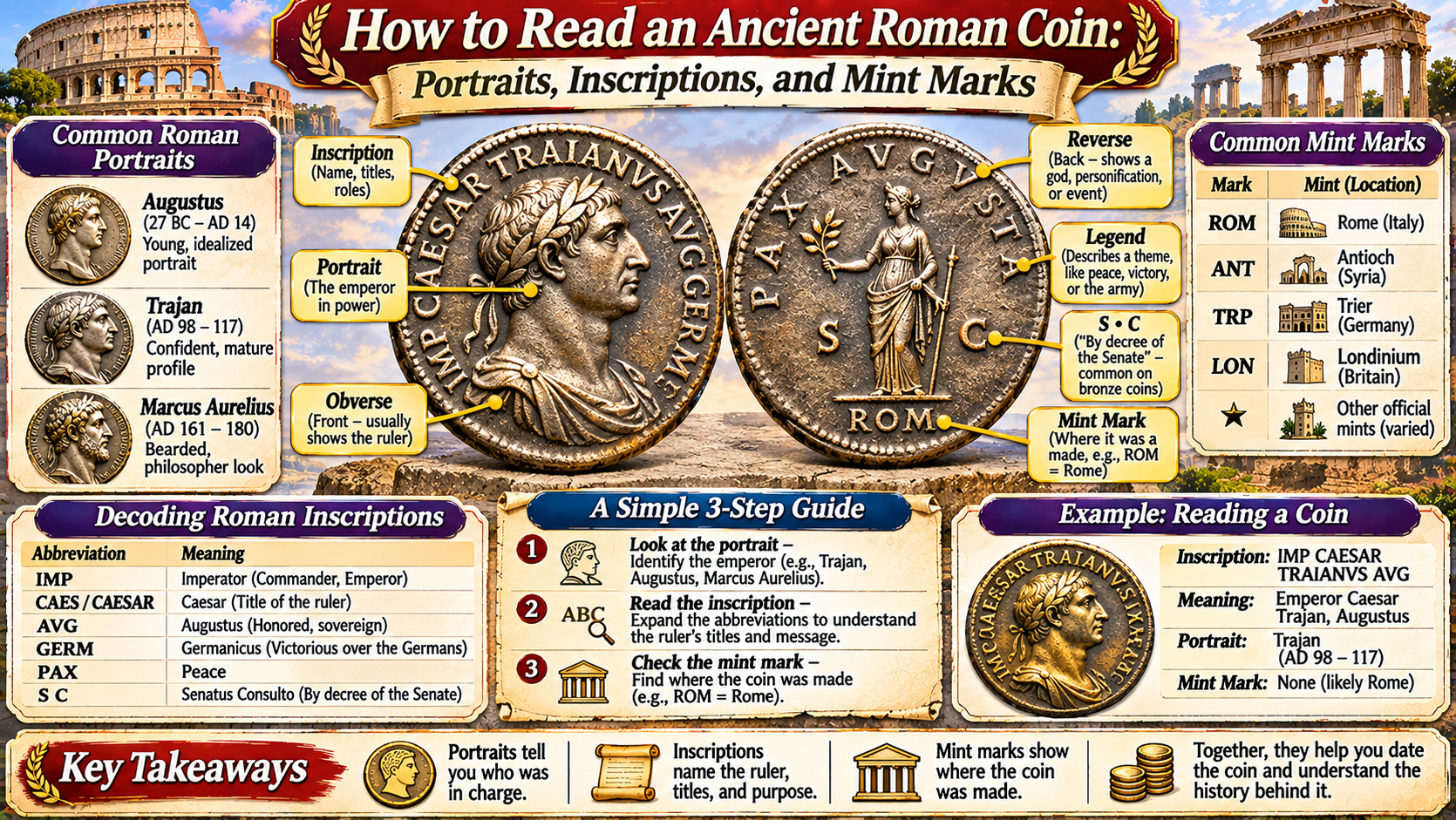
Crucially, Augustus transformed every coin into an instrument of mass communication. In an ancient empire lacking mass media, printing presses, or electronic telecommunications, coins were the only physical objects bearing the verified likeness of the Emperor that reached the hands of every legionary stationed on Hadrian’s Wall, every grain merchant in Alexandria, and every peasant in Hispania. The obverse showcased the dignified, perpetually youthful portrait of the Emperor, encircled by his official titles (such as PONTIFEX MAXIMUS, TRIBUNICIA POTESTATE, and IMPERATOR), while the reverse functioned as an imperial news bulletin. Reverses celebrated military triumphs (ARMENIA CAPTA), public infrastructure completions (such as newly constructed aqueducts, bridges, and roads), civic largesse (CONGIARIUM), and ideological concepts of peace and abundance (PAX AUGUSTA, ANNONA AUGUSTI).
| Emperor / Era | Reign Dates | Coin Weight (Grams) | Silver Purity Percentage | Pure Silver Content (Grams) | Economic / Military Context |
|---|---|---|---|---|---|
| Augustus | 27 BCE – 14 CE | 3.85 g | 98.0% Silver | 3.77 g | Stable golden age; Pax Romana; treasury funded by Egyptian annexation |
| Nero (Reform of 64 CE) | 54 – 68 CE | 3.40 g | 93.5% Silver | 3.18 g | First official reduction to fund rebuilding of Rome after Great Fire |
| Trajan | 98 – 117 CE | 3.35 g | 89.0% Silver | 2.98 g | Dacian gold influx stabilizes finances; vast public building projects |
| Marcus Aurelius | 161 – 180 CE | 3.25 g | 76.0% Silver | 2.47 g | Antonine Plague decimates economy; costly Marcomannic Wars along Danube |
| Septimius Severus | 193 – 211 CE | 3.20 g | 54.0% – 58.0% Silver | 1.79 g | Doubles legionary wages; militarizes state budget; severe debasement |
| Caracalla (Antoninianus) | 198 – 217 CE | 5.10 g (Double Denarius) | 50.0% Silver | 2.55 g | Introduces radiating crown coin valued at 2 denarii but containing only 1.5x silver |
| Gordian III | 238 – 244 CE | 4.40 g | 35.0% Silver | 1.54 g | Antoninianus replaces denarius entirely as primary circulation piece |
| Gallienus (Crisis Zenith) | 253 – 268 CE | 2.60 g | 2.5% – 5.0% Silver | 0.08 g | Hyperinflation; base bronze pellets washed in microscopic silver dip |
| Diocletian (Reform of 294) | 284 – 305 CE | 3.20 g (Argenteus) | 95.0% Silver | 3.04 g | Restores pure silver argenteus; introduces Follis; Edict on Maximum Prices |
⚖️
Part II: The Mechanics of Inflation
The Slippery Slope of Debasement: From Nero’s Reform to Severan Militarism
The fatal fiscal vulnerability of the Roman Empire was that its budget was overwhelmingly dominated by military expenditure. Roman emperors did not possess bond markets, treasury bills, or central banks capable of borrowing future capital. When state expenditures exceeded annual tax revenues—driven by catastrophic barbarian invasions, civil war payouts, devastating plagues, or lavish imperial building monuments—the imperial court faced a stark choice: raise direct taxes on an impoverished provincial peasantry, or secretly debase the coinage. Unsurprisingly, emperors repeatedly chose the path of least political resistance: covert metallurgical debasement.
The first crack in the pristine Augustan standard occurred in 64 CE under Emperor Nero. Confronted by the colossal financial burden of rebuilding Rome following the devastating Great Fire and constructing his opulent Golden House (Domus Aurea), Nero reduced the weight of the denarius from 3.85 grams down to 3.40 grams (striking 96 denarii to the pound instead of 84) and, for the first time, lowered the silver purity from 98 percent to roughly 93.5 percent by adding copper alloy. Simultaneously, Nero reduced the gold aureus from 7.8 grams down to 7.3 grams. While subtle enough to escape immediate rejection in the markets, Nero had established a catastrophic administrative precedent: the Roman state could manufacture artificial purchasing power simply by lowering the precious metal content of its coins.
Over the subsequent century, successive emperors chipped away at the denarius. Trajan, despite conquering Dacia and capturing over three hundred thousand pounds of gold, reduced silver purity to 89 percent to finance his grand Forum and continuous Parthian campaigns. By the reign of Marcus Aurelius (161–180 CE), the horrific Antonine Plague wiped out up to a third of the empire’s population, drastically shrinking the tax base while the emperor fought desperate defensive campaigns against Germanic tribes along the frozen Danube, forcing silver content down to 76 percent. The watershed moment arrived with Septimius Severus (193–211 CE), who seized the throne in a bloody civil war and bought the loyalty of the legions by raising military wages by over sixty percent. On his deathbed, Severus famously advised his sons Caracalla and Geta: ‘Agree with each other, enrich the soldiers, and despise everyone else.’ To fund this military bribe, Severus slashed the denarius to 54 percent purity, transforming it into a visibly coppery, tarnished coin.
🏛️
Part III: Hyperinflationary Collapse
The Antoninianus and the Cataclysmic Third Century Crisis
By the early third century, the traditional denarius had become economically untenable. In 215 CE, Emperor Caracalla introduced a radical new silver denomination designed to extract a hidden tax from the population: the antoninianus (termed the radiate by modern numismatists). Iconographically, the coin was distinguished by portraying the emperor wearing a radiating solar crown (corona radiata) on the obverse, while female imperial portraits featured the empress’s bust resting upon a crescent moon. The antoninianus was tariffed by royal decree as a double denarius—worth exactly two denarii in payment of debts and taxes.
However, in metallurgical reality, the antoninianus weighed only about 5.1 grams (approximately 1.5 times the weight of a single denarius) and contained roughly 50 percent silver. Through this mathematical sleight of hand, the imperial treasury confiscated thirty percent of the silver value on every transaction, minting millions of radiates while hoarding older, purer Augustan and Antonine denarii to melt down. Gresham’s Law—the economic principle that bad money drives good money out of circulation—manifested across the empire with brutal velocity: citizens systematically hoarded high-purity older denarii in buried ceramic pots, while spending the debased radiates immediately.
During the disastrous Third Century Crisis (235–284 CE)—a fifty-year nightmare characterized by more than thirty rival military usurpers, the secession of the Gallic and Palmyrene Empires, devastating Gothic invasions, and the capture of Emperor Valerian by Sasanian Persia—the monetary system experienced complete hyperinflationary collapse. Under Emperor Gallienus (reigned 253–268 CE), the silver content of the antoninianus plummeted to an astonishing 2.5 to 5 percent. The coins were no longer silver at all; they were coarse bronze and potin pellets struck on ragged planchets and given a microscopic chemical ‘wash’ or blanching of silver that rubbed off within days of market handling. Prices for essential commodities like wheat soared by thousands of percent, Roman soldiers refused payment in debased base-metal coins and demanded direct payouts in grain, weapons, and pure gold bullion, and entire provinces reverted to primitive agrarian barter.
👑
Part IV: Diocletian & Constantine
Diocletian’s Restoration, the Solidus, and Late Roman Monetary Legacy
The restoration of monetary order required the iron-fisted administrative restructuring of Emperor Diocletian (reigned 284–305 CE). After establishing the administrative Tetrarchy to govern the sprawling empire, Diocletian launched a comprehensive currency overhaul in 294 CE. Recognizing that the antoninianus was utterly discredited, he introduced the pure silver argenteus (struck at 96 to the pound, replicating Nero’s early silver standard) and a substantial new silver-washed bronze coin known as the nummus or follis. To curb the runaway wage-price spiral triggered by decades of debasement, Diocletian enacted his famous Edict on Maximum Prices in 301 CE, imposing the death penalty on merchants who sold goods or demanded wages above federally mandated caps. While the price controls proved unenforceable and were quickly abandoned, the structural reorganization laid the groundwork for fourth-century stabilization.
The permanent foundation of late antique and medieval European finance was forged by Diocletian’s successor, Constantine the Great. In 312 CE, Constantine introduced the gold solidus, struck at 72 to the Roman pound (weighing exactly 4.5 grams) of pristine 98 percent pure gold. Unlike the tragic silver denarius, the Byzantine Empire and late Roman state maintained the weight and purity of the gold solidus unyielding for over seven hundred years—earning it the modern title ‘the dollar of the Middle Ages’ and serving as the direct ancestor of European gold coinages from the Italian florin to the French sou and British shilling.
Today, Roman imperial coins represent one of the richest, most historically educational fields of numismatics. Because millions of denarii and radiates were buried in ceramic hoards across Britain, France, Germany, and the Balkans during barbarian raids and civil wars, thousands of authentic specimens survive in immaculate condition. Modern collectors can purchase an authentic silver denarius of Emperor Trajan, Hadrian, or Septimius Severus for relatively modest sums, holding in their hand a genuine piece of the Pax Romana that once purchased grain in the shadow of the Colosseum or paid a legionary standing watch on the banks of the Rhine.
Key Takeaways: Roman Currency Dynamics
Augustus’s Trimettalic System: Gold aurei, silver denarii, and orichalcum sestertii created a unified, mathematically harmonized economic engine across three continents.
Imperial Propaganda Vehicle: Coins operated as the Roman mass media, broadcasting portraits, victories, new monuments, and imperial virtues to soldiers and citizens.
Fiscal Trap of Debasement: Escalating military budgets prompted emperors from Nero to Severus to covertly reduce silver content, ultimately destroying the denarius.
Third Century Hyperinflation: The Antoninianus collapsed to 2.5% silver under Gallienus, triggering an economic implosion that was only halted by Diocletian’s reforms and Constantine’s gold solidus.
The Plague of Ancient Fourrées and Sulla’s Anti-Counterfeiting Laws
Beyond official imperial debasement conducted within the state mints of Rome, Antioch, and Lugdunum, the ancient Roman economy was continuously saturated with sophisticated illicit counterfeit coins known to modern numismatists as fourrées (from the French for ‘stuffed’ or ‘sheathed’). A Roman fourrée was an ingenious, fraudulent composite coin constructed by wrapping a cheap base-metal core—typically copper, bronze, or lead—inside an ultra-thin silver foil sheet, heating the assembly in a furnace until the silver and copper formed a eutectic surface bond, and subsequently striking the heated planchet between counterfeit dies. When freshly struck, a fourrée was visually indistinguishable from an authentic solid silver denarius, possessing identical device luster and sharp relief. However, as the coin circulated through taverns and market stalls, high points on the emperor’s nose or laurel wreath rubbed away, exposing the telltale reddish copper core beneath.
The proliferation of fraudulent plated currency caused severe commercial panic in Republican and Imperial Rome. In 81 BCE, Dictator Lucius Cornelius Sulla enacted the severe Lex Cornelia de falsis, which established harsh capital punishments for counterfeiters, sentencing free citizens to exile and asset confiscation and slaves to crucifixion or being thrown to beasts in the amphitheater. Furthermore, Roman moneyers instituted testing notches, serrated edges (denarii serrati), and chisel cuts to help merchants verify that a coin was solid silver throughout. In the Roman marketplace, professional bankers known as nummularii operated exchange tables equipped with balance scales, touchstones (lapis Lydius), and bronze clippers, charging small commissions to test coin purity by dropping pieces onto marble slabs to evaluate their acoustic ring—a dull clink indicating a hollow or base-metal core, while a high, sustained musical ping confirmed high-purity solid silver.
The dramatic velocity of Roman monetary collapse is most vividly demonstrated through modern archaeological discoveries of colossal buried coin hoards across western Europe. During the apex of the Third Century Crisis, terrified provincial landowners and legionaries buried their savings in ceramic jars before fleeing barbarian warbands, never returning to recover their wealth. Famous British discoveries such as the Cunetio Hoard—unearthed in Wiltshire in 1978, containing over 54,951 debased radiates—and the 2010 Frome Hoard of 52,503 coins reveal the exact trajectory of panic hoarding. Within these hoards, older high-silver denarii of Marcus Aurelius and Septimius Severus were systematically culled and sequestered, while millions of virtually worthless bronze radiates of Gallienus and Claudius Gothicus circulated at frantic velocity until the monetary structure dissolved entirely.