MONETARY HISTORY / SYMBOLS & CIVILIZATION
The Hidden History Behind the Symbols of Money
From Spanish silver coins to modern currency design, discover how familiar monetary symbols became part of everyday financial language.
Currency symbols are among the most recognizable marks in modern communication.
The dollar sign appears on price tags, financial statements, advertisements, and computer keyboards. The pound, euro, yen, and rupee symbols are similarly familiar in different parts of the world.
Yet these small characters have surprisingly complex histories.
Some evolved from handwritten abbreviations used by merchants and accountants. Others developed from older alphabets, traditional units of weight, or deliberate modern design competitions.
The dollar sign is especially interesting because its exact origin remains a subject of historical discussion.
To understand why we write $ for dollars, we need to look beyond the United States and examine the international trade networks that existed before the American dollar became a national currency.
Why Do Currencies Have Symbols?
Currency symbols provide a compact way to identify monetary values.
Instead of writing the full name of a currency every time, merchants and accountants can use a short, recognizable mark.
This saves space and makes financial records easier to read.
Historically, commercial transactions often involved handwritten ledgers, invoices, shipping documents, and letters.
Repeatedly writing long currency names was inconvenient, especially when recording many transactions.
Abbreviations gradually became standardized through widespread use.
Some of those abbreviations developed into distinctive symbols.
Modern currency signs also serve an international purpose. They help distinguish monetary amounts in printed and digital communication.
However, a symbol does not always identify one currency uniquely.
For example, the dollar sign is used by several countries, making additional information necessary in some contexts.
Where Did the Dollar Sign Come From?
The dollar sign is generally associated with the United States today, but its history began before the modern US dollar was established.
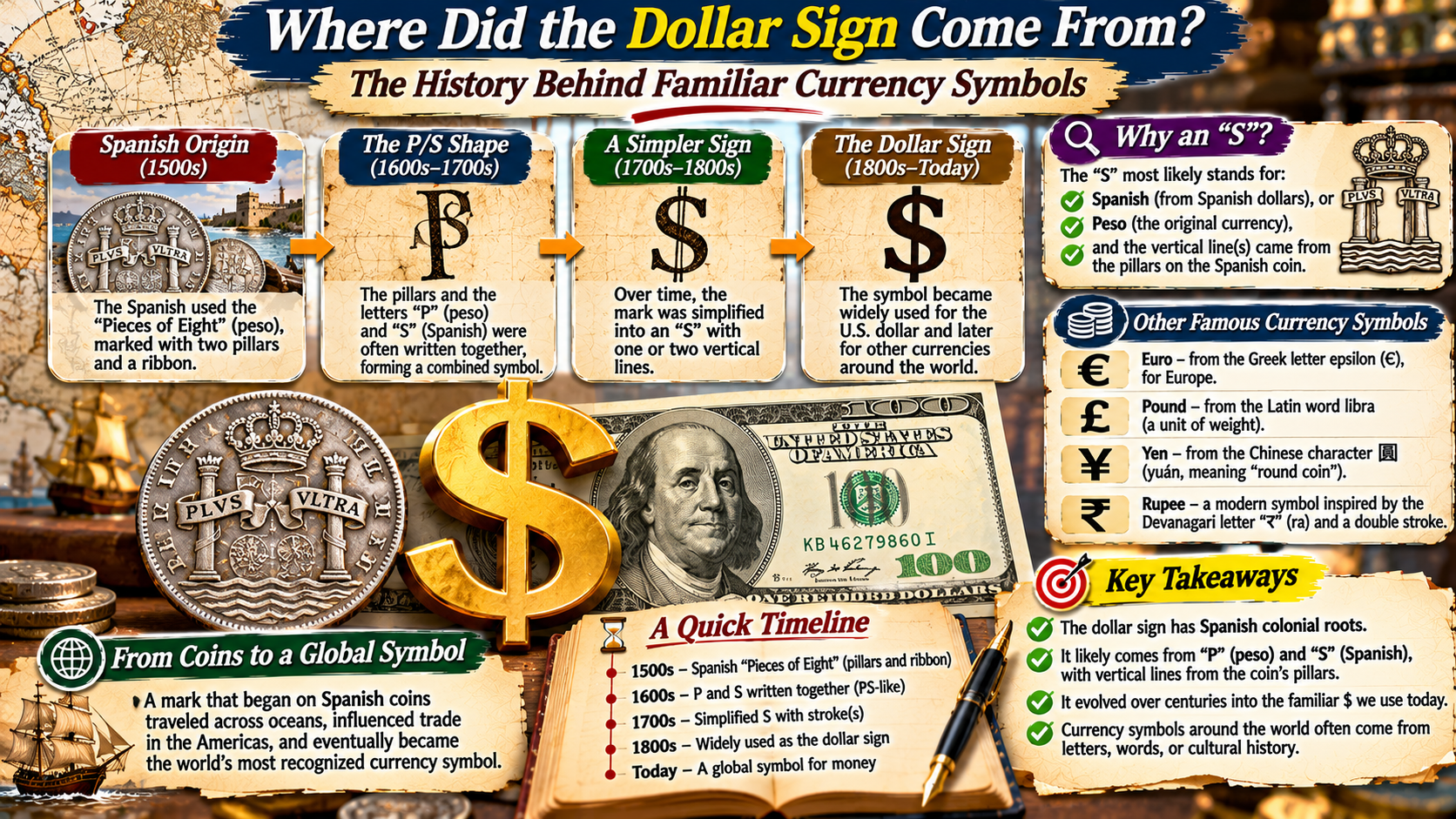
One of the strongest explanations connects the symbol to the Spanish peso, a widely circulated silver currency.
During the colonial period, Spanish silver coins were important in trade throughout the Americas and beyond.
These coins were often called Spanish dollars in English-speaking regions.
They circulated alongside other forms of money in colonial North America.
Because Spanish dollars were so common, merchants needed convenient ways to record transactions involving them.
The abbreviation for pesos appears to have played an important role in the development of the dollar sign.
The Spanish Peso Abbreviation Theory
A leading explanation suggests that the dollar sign evolved from the handwritten abbreviation ps, used for pesos.
In handwritten financial records, letters were sometimes combined or written over one another.
Over time, a superimposed or simplified version of the abbreviation may have developed into a character resembling the modern dollar sign.
This explanation is supported by historical examples of evolving commercial notation.
However, the exact sequence of handwriting changes is difficult to reconstruct with complete certainty.
HISTORICAL INTERPRETATION / DOLLAR SIGN
Spanish Pesos → Handwritten “ps” → Dollar Sign
This is a widely accepted explanation of the symbol’s development, although historians cannot document every intermediate stage with absolute certainty.
Did the Dollar Sign Come from the Pillars of Hercules?
Another theory connects the dollar sign to imagery found on Spanish coins.
Some Spanish silver coins displayed the Pillars of Hercules, a traditional symbol associated with the entrance to the Mediterranean Sea.
Ribbons or scrolls wrapped around the pillars in certain designs.
These features have sometimes been compared with the vertical strokes and curved shape of the dollar sign.
The resemblance is visually interesting, but it does not by itself prove that the currency symbol originated from the coin design.
The handwritten peso-abbreviation explanation generally has stronger documentary support.
The Pillars of Hercules theory remains part of the popular discussion surrounding the symbol’s history.
Why Do Some Dollar Signs Have Two Vertical Lines?
The dollar sign appears in more than one typographic form.
Some versions use a single vertical stroke through the S-shaped character.
Others use two vertical strokes.
These differences are largely matters of handwriting, typography, and font design.
They do not indicate different monetary values.
Both styles have been used historically.
The two-stroke version is sometimes linked to theories involving the Pillars of Hercules or overlapping letters, but the visual form alone cannot establish a definitive origin.
In modern digital systems, the standard dollar-sign character is usually displayed according to the chosen font.
How the Dollar Became America’s Currency
Before the United States established its own monetary system, several types of coins circulated in the American colonies.
Spanish dollars were especially important because they were widely recognized in international commerce.
The United States adopted the dollar as its principal monetary unit during the development of its national financial system.
The Coinage Act of 1792 formally established the US Mint and defined the dollar within the new federal coinage system.
By that time, the dollar sign was already associated with monetary notation.
The symbol therefore did not need to be invented specifically for the United States.
Instead, it became closely associated with the American dollar as the country’s currency gained prominence.
Today, the dollar sign is also used for currencies in Canada, Australia, New Zealand, and several other countries.
When clarity is important, writers may use designations such as US$, C$, or A$, or standardized currency codes.
The Pound Sign (£): A Connection to Ancient Rome
The British pound symbol has a different historical origin.
It developed from the letter L, associated with the Latin word libra.
In ancient Rome, libra referred to a unit of weight.
The historical connection between money and weight is important because precious metals were often measured by weight in early monetary systems.
Over time, a stylized L became associated with the pound sterling.
The horizontal stroke helped distinguish the currency sign from an ordinary letter.
Although the symbol has changed in appearance through handwriting and typography, its connection to libra remains central to its history.
CURRENCY ORIGIN / BRITISH POUND
Libra → L → £
The pound symbol preserves a historical link between monetary value, Latin terminology, and traditional systems of weight.
The Euro Symbol (€): A Modern Currency Design
Unlike the dollar and pound signs, the euro symbol was deliberately designed for a modern currency.
The euro was developed as part of European monetary integration.
Its symbol was selected during preparations for the currency’s introduction.
The European Commission has explained that the design draws inspiration from the Greek letter epsilon, reflecting the historical roots of European civilization.
The symbol also resembles the first letter of the word Europe.
Its two parallel horizontal lines were intended to represent stability.
The euro was introduced for electronic and accounting purposes in 1999, while euro banknotes and coins entered circulation in 2002.
The € symbol quickly became one of the world’s most recognizable monetary signs.
The Yen and Yuan Symbol (¥)
The ¥ symbol is associated with both the Japanese yen and the Chinese yuan.
Its shape is based on the Latin letter Y with horizontal strokes.
The symbol reflects romanized currency names rather than a direct adaptation of traditional Chinese or Japanese characters.
In Japanese, the yen is written using the character 円.
In Chinese, yuan is commonly represented by 元, while 圆 or 圓 may also appear in relevant contexts.
Because the yen and yuan can share the ¥ symbol, financial documents often use standardized currency codes such as JPY and CNY.
This helps avoid confusion in international transactions.
The shared symbol illustrates how monetary notation can become standardized across different writing systems while still requiring additional context.
The Indian Rupee Symbol (₹): A Modern National Identity
The Indian rupee symbol is another example of deliberate modern currency design.
India officially adopted the ₹ symbol in 2010.
It was designed by D. Udaya Kumar, whose proposal was selected through a national competition.
The design combines elements of the Devanagari letter र and the Latin letter R.
Its horizontal lines create a distinctive appearance and are commonly interpreted as reflecting the Indian tricolor and an equality-like visual motif.
The symbol was intended to give the Indian rupee a recognizable identity in international financial communication.
Before its adoption, the abbreviation Rs. was widely used.
That abbreviation remains recognizable, but ₹ is now the official currency symbol.
Comparing Familiar Currency Symbols
| Symbol | Currency | Historical Origin |
|---|---|---|
| $ | Dollar and other currencies | Widely linked to Spanish peso abbreviations |
| £ | Pound sterling | Stylized L from Latin libra |
| € | Euro | Modern design inspired by epsilon and Europe |
| ¥ | Yen and yuan | Stylized Y associated with romanized currency names |
| ₹ | Indian rupee | Modern design combining Devanagari and Latin letterforms |
Why Currency Symbols Often Have Horizontal Lines
Several familiar currency symbols contain one or more horizontal strokes.
Examples include the pound, euro, yen, and rupee signs.
However, these strokes do not share one universal historical meaning.
In some symbols, they developed through handwriting conventions.
In others, they were included deliberately as part of modern graphic design.
For the euro, the parallel lines were officially associated with stability.
For the rupee, the horizontal elements contribute to the symbol’s visual identity.
It would therefore be misleading to claim that every currency symbol uses lines to represent the same concept.
Their meanings depend on their individual histories.
Currency Symbols vs. Currency Codes
Currency symbols are useful for everyday communication, but they can create ambiguity.
The dollar sign, for example, does not automatically identify whether an amount refers to US dollars, Canadian dollars, or Australian dollars.
International financial systems therefore use standardized three-letter currency codes.
These codes are defined under ISO 4217.
Examples include USD for the United States dollar, GBP for the British pound, EUR for the euro, JPY for the Japanese yen, and INR for the Indian rupee.
Currency codes are especially important in banking, accounting, foreign exchange, and cross-border payments.
They provide greater precision when several currencies share similar names or symbols.
How Printing and Computers Changed Currency Symbols
Early currency notation depended heavily on handwriting.
As printing became widespread, printers needed consistent characters that could be reproduced using movable type and later mechanical typesetting systems.
Some symbols became standardized through these technologies.
Modern computers introduced additional requirements.
Currency signs needed reliable digital character encoding so that documents could be exchanged between devices and languages.
Unicode now provides character representations for many currency symbols.
Fonts determine how those characters appear on screen or in print.
This explains why the same currency symbol may look slightly different across websites, documents, and devices.
Despite these variations, its underlying character and monetary meaning remain recognizable.
Common Myths About the Dollar Sign
Myth: The dollar sign was invented by the United States government.
The symbol developed from earlier monetary notation and was in use before the US dollar became established.
Myth: The dollar sign definitely represents the letters U and S.
This explanation is popular but lacks the historical support associated with the Spanish peso abbreviation theory.
Myth: Two vertical lines always mean a different currency.
Single-stroke and double-stroke dollar signs are typographic variations rather than separate denominations.
Myth: Every currency symbol has one officially documented origin.
Some symbols evolved gradually, making their earliest development difficult to establish with certainty.
Frequently Asked Questions
Who invented the dollar sign?
No single inventor has been conclusively established. The strongest historical explanation connects the symbol to handwritten abbreviations for Spanish pesos.
Did the dollar sign exist before the United States?
Yes. Dollar-sign notation developed from monetary practices that predated the establishment of the modern US dollar.
Why does the dollar sign have an S shape?
One leading theory links its shape to the handwritten abbreviation “ps” for pesos, which may have gradually developed into the familiar symbol.
What does the pound sign represent?
The £ symbol developed from a stylized L associated with the Latin word libra, a historical unit of weight.
Who designed the Indian rupee symbol?
D. Udaya Kumar designed the ₹ symbol, which India officially adopted in 2010.
Why do Japan and China use the same currency symbol?
The ¥ symbol is associated with the romanized names yen and yuan. Standardized codes such as JPY and CNY distinguish the currencies.
What is the difference between $ and USD?
The dollar sign is a currency symbol used by several countries, while USD is the standardized code specifically identifying the United States dollar.
Final Thoughts
Currency symbols are small pieces of writing with surprisingly long histories.
The dollar sign reflects the influence of Spanish silver currency and early commercial notation.
The pound symbol preserves a connection to ancient Roman systems of weight.
The euro and Indian rupee symbols demonstrate how modern governments can deliberately create recognizable monetary identities.
The yen and yuan symbol illustrates how similar written forms can be shared across different currencies.
Although these marks appear simple, they reveal the influence of trade, language, politics, typography, and technology.
Every time we write a price using $, £, €, ¥, or ₹, we are using a symbol shaped by a much larger history of money and communication.