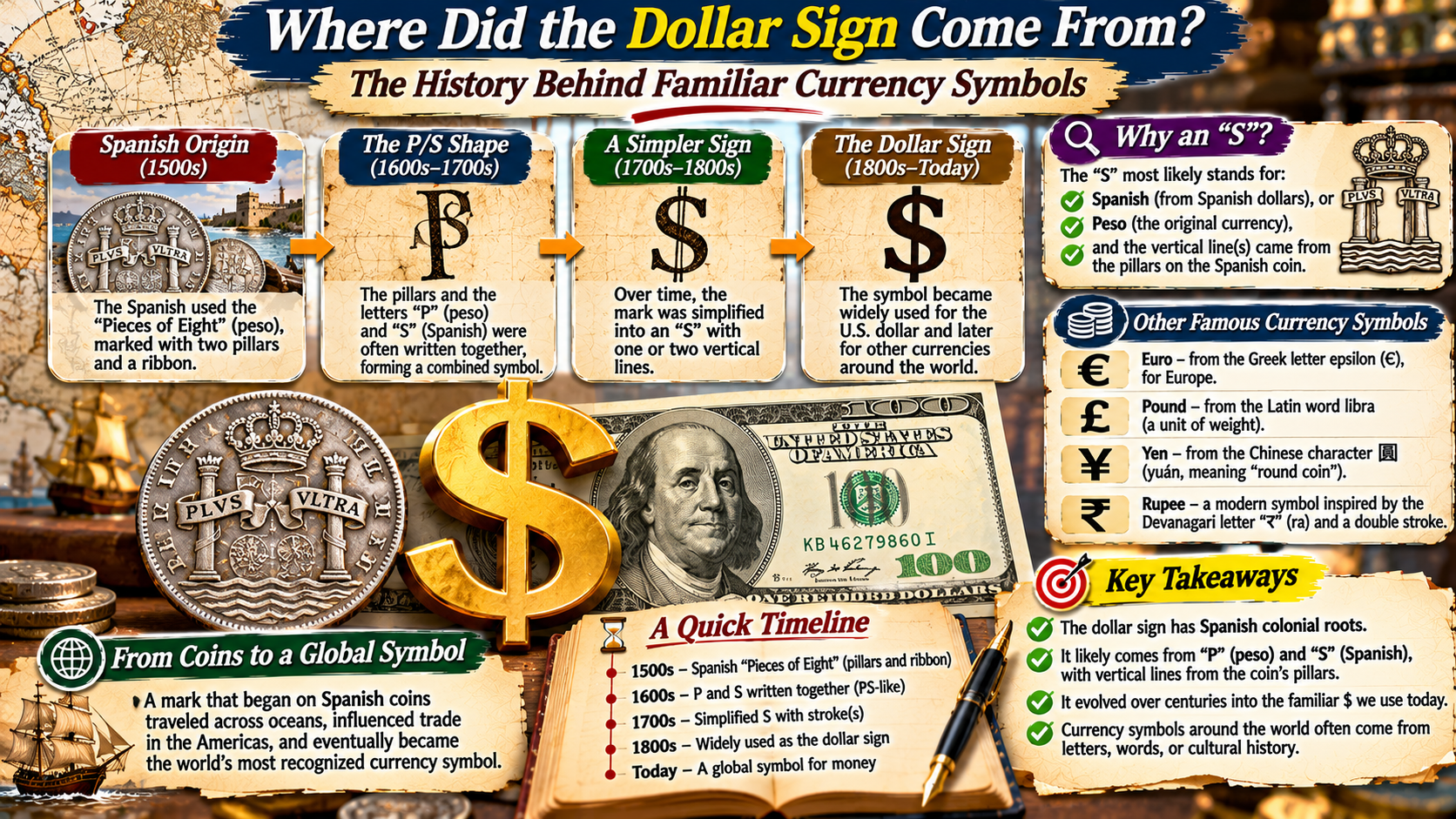
East Asian Monetary Symbology: The Etymological Triangle of the Round Coin
The dominant national currencies of East Asia—the Japanese Yen (¥), the Chinese Yuan (元 / ¥), and the South Korean Won (₩)—share a profound, interconnected linguistic and numismatic ancestry rooted in a single shared semantic concept: ’roundness’ or a circular coin.
Through nineteenth-century modernization, the arrival of Western silver trade dollars, and the evolution of international typography, these three sovereign currencies developed distinctive graphic identities that reflect both ancient East Asian calligraphic traditions and the standardized Latin double-crossbar convention.
🪙
Part I: Linguistic Unity
The Shared Classical Etymology: The Concept of the Round Object
To understand why Japan, China, and Korea utilize currency symbols that share striking typographical and linguistic parallels, one must examine the classical Chinese writing system that served as the shared administrative script across pre-modern East Asia. Historically, traditional Chinese cash coins were pierced by square holes and designated by weight units (such as the Ban Liang and Wu Zhu) or reign mottos (Tong Bao). However, in everyday vernacular speech, merchants referred to circular coins using descriptive characters indicating roundness.
The primary classical character was yuán (圓), composed of the outer enclosing square radical (wéi, 囗) surrounding the phonetic and semantic component yuán (員), literally meaning ‘circle’, ‘spherical’, or ’round object’. When the Spanish silver Piece of Eight and Mexican silver trade dollar flooded East Asian maritime ports during the Ming and Qing dynasties via the Manila Galleon trade, Chinese merchants immediately christened these substantial foreign coins yín yuán (銀圓, ‘silver rounds’) to distinguish them from cast copper cash coins and irregular silver sycee ingots (yuánbǎo).
Because classical Chinese characters were borrowed across East Asia, this identical linguistic root was adopted across the region with localized pronunciations: in China, 圓 was pronounced yuán; in Japan, the character was adopted into the kanji lexicon with the Sino-Japanese pronunciation en (producing the modern Yen); and in Korea, the Hanja character was pronounced won. In modern Chinese writing, the complex 13-stroke traditional character 圓 was simplified in everyday financial commerce to the streamlined, homophonous 4-stroke character yuán (元), meaning ‘first’, ‘primary’, or ‘head’, establishing the formal dual character set that persists today.
| Currency Name | Nation / Central Bank | Native Script Characters | Latin Currency Symbol | ISO Code & Historical Introduction |
|---|---|---|---|---|
| Japanese Yen | Japan (Bank of Japan) | 円 (Simplified Kanji), 圓 (Traditional) | ¥ (Capital ‘Y’ with two horizontal bars) | JPY; introduced under the New Currency Act of Meiji 4 (1871) |
| Chinese Yuan (Renminbi) | China (People’s Bank of China) | 元 (Simplified), 圓 (Traditional), 人民币 | ¥ (or Ұ, Capital ‘Y’ with horizontal bar) | CNY / RMB; modern Renminbi established by PBOC in December 1948 |
| South Korean Won | South Korea (Bank of Korea) | 원 (Hangul), 圓 (Hanja) | ₩ (Capital ‘W’ with two horizontal bars) | KRW; re-introduced in 1962 replacing the temporary Hwan (환) |
| New Taiwan Dollar | Taiwan (Central Bank of the ROC) | 新臺幣 (元 / 圓) | NT$ (or $ / 元) | TWD; established in June 1949 to halt hyperinflation of Old Taiwan Dollar |
| North Korean Won | North Korea (Central Bank of the DPRK) | 원 (Hangul), 朝鮮圓 | ₩ (Capital ‘W’ with horizontal bars) | KPW; established in December 1947 replacing the colonial Yen |
⚖️
Part II: The Japanese Yen
The Meiji Restoration and the Birth of the Japanese Yen (¥)
The modern Japanese Yen was born out of the revolutionary upheaval of the Meiji Restoration in 1868. Under the preceding Tokugawa Shogunate, Japan operated a notoriously complex, fragmented feudal monetary system known as the Sanka (three currencies), where gold koban plates, silver bar ingots, and copper cash coins circulated with fluctuating, arbitrary exchange ratios across dozens of autonomous samurai clan domains (han). This feudal fragmentation paralyzed international trade when Western powers forced open Japanese ports following Commodore Matthew Perry’s expedition in 1853.
Recognizing that industrial modernization required a centralized, Western-style decimal currency, the Meiji government enacted the New Currency Act (Shinka Jōrei) on May 10, 1871. Championed by modernizing leaders like Itō Hirobumi and Shibusawa Eiichi, the act unified Japanese currency under the Yen (円). In a brilliant technological acquisition, Japan purchased the entire state-of-the-art steam-powered minting machinery from the British colonial Hong Kong Mint (which had closed in 1868), shipping the heavy presses and furnaces to Osaka to construct the monumental Japan Mint (Zōheikyoku).
The newly minted Meiji gold and silver yen coins featured breathtaking neo-traditional Japanese iconography: confronting imperial dragons clutching the flaming pearl of wisdom on the obverse, surrounded by sunbursts, imperial chrysanthemum crests, and paulownia wreaths. When transliterating the currency for international exchange and foreign commerce, Western diplomats and merchants added a ‘Y’ to the phonetic pronunciation (rendering ‘en’ as ‘Yen’) due to historic Portuguese-Japanese dictionary romanization conventions dating back to the sixteenth century. When creating an international symbol for the Yen, designers adopted the Western standard of placing horizontal crossbars through the initial Latin capital letter—transforming ‘Y’ into the iconic ¥ symbol, with two horizontal crossbars mirroring the British pound (£) and Spanish-American dollar ($).
🏛️
Part III: The Chinese Yuan
The Chinese Yuan and the Dual Renminbi Identity
The monetary landscape of modern China is unique in world finance because its sovereign currency possesses two distinct official designations: the unit of account is the Yuan (元), while the currency itself is officially named the Renminbi (人民币, RMB), translating literally to ‘the People’s Currency’. This dual nomenclature reflects the revolutionary origins of the People’s Republic of China. As the Chinese People’s Liberation Army advanced across northern China in late 1948, the newly founded People’s Bank of China (PBOC) issued the first series of Renminbi on December 1, 1948, to eliminate the catastrophic hyperinflation that had utterly destroyed the legacy Nationalist (KMT) Fabi paper currency.
In everyday domestic commerce, prices in China are universally denominated using the character 元 (Yuan), or the colloquial market term kuài (块, literally meaning ‘a chunk’ or ‘lump’ of silver, inherited from nineteenth-century silver bullion exchange). However, in international banking, foreign exchange accounting, and computer typography, the Chinese Yuan is designated using the Latin letter ‘Y’ with a horizontal crossbar. A fascinating typographic dispute persists in international font design: while official Chinese typographic authorities frequently render the Yuan symbol with a single horizontal crossbar (Ұ) to distinguish it visually from the Japanese Yen, international Unicode standards map both the Japanese Yen and Chinese Yuan to the identical code point: U+00A5 (¥).
To resolve this digital ambiguity in automated international financial systems, global banking networks rely upon the ISO 4217 currency codes: JPY for the Japanese Yen and CNY (or the common financial acronym RMB) for the Chinese Yuan Renminbi. As China expands the global footprint of its sovereign currency through the Cross-Border Interbank Payment System (CIPS) and the rollout of the digital e-CNY, the iconic ¥ glyph has emerged as one of the definitive structural symbols of twenty-first-century global trade.
👑
Part IV: The Korean Won
The Korean Won (₩): From Imperial Mun to the Miracle on the Han River
The South Korean Won (₩) represents a heroic narrative of economic rebirth following the devastation of colonial occupation and war. During the Joseon Dynasty (1392–1897), Korea operated a traditional cast bronze cash system centered upon the Sangpyeong Tongbo (Mun). In 1902, the brief Korean Empire (Daehan Jeguk) under Emperor Gojong attempted to modernize by introducing the first silver Won, divided into one hundred Chon. However, the Japanese annexation of Korea in 1910 dissolved Korean monetary sovereignty, replacing national currency with the Bank of Chosen Yen.
Following liberation in 1945 and the catastrophic devastation of the Korean War (1950–1953), the newly established Republic of Korea suffered extreme hyperinflation that forced recurring monetary resets. In 1953, the government replaced the depreciated won with the Hwan (환) at a rate of 100 to 1. Finally, on June 10, 1962, under President Park Chung-hee, South Korea instituted a sweeping monetary reform that permanently reinstated the Won (원) as the sovereign national currency, exchanging 10 Hwan for 1 new Won.
The Latin currency symbol for the Won was engineered by taking the capitalized initial letter ‘W’ of the romanized name and superimposing two horizontal crossbars directly through the center: ₩. This double-crossbar architecture deliberately aligned the Won with the prestige and typographic tradition of the British pound (£) and Japanese Yen (¥). In modern computer software and Asian operating systems, the Won symbol possesses a unique typographical quirk: on Korean-language Windows keyboards and font sets, the reverse slash key (\) automatically displays as the Won symbol (₩) due to legacy byte mappings, embedding the national currency glyph into the very structural code of South Korean software.
📜
Part V: Typographic Geometry
The Universal Double Crossbar: A Global Typographic Convention
Examining the Yen (¥), Yuan (¥), and Won (₩) alongside Western currency symbols reveals a profound, unwritten law of global graphic design: the supremacy of the horizontal crossbar. From the British pound (£) and the Euro (€) to the Indian Rupee (₹), the Philippine Peso (₱), and the Nigerian Naira (₦), international typographers consistently modify standard phonetic letters by striking one or two horizontal parallel lines through their vertical stems.
Graphic designers and paleographers identify two fundamental reasons for this universal geometric convention. First, semiotic distinction: in handwritten commercial accounting and high-speed financial ledgers, an unadorned letter ‘Y’ or ‘W’ could easily be mistaken for an algebraic variable, an initial, an abbreviation, or a grammatical word. The horizontal strike immediately informs the human eye that the character has been transformed from a phonetic sound into a sovereign economic token. Second, institutional dignity: the horizontal crossbars symbolize stability, balance, and the horizontal scales of justice, projecting sovereign fiscal authority across domestic markets and international exchange bourses.
Today, East Asian currency symbols represent the economic heartbeat of more than 1.5 billion people. Struck on high-denomination polymer banknotes, integrated into smartphone digital wallets, and processed in trillions of dollars of daily global manufacturing supply chains, the Yen (¥), Yuan (¥), and Won (₩) continue to honor their ancient shared etymological heritage: the eternal circle of the round coin that has powered Asian civilization for millennia.
Key Takeaways: Asian Currency Symbols
The Shared Root of Roundness: The Yen, Yuan, and Won all derive from the identical classical Chinese character (圓), meaning a round coin or spherical object.
Meiji Westernization: Japan created the modern Yen in 1871 using purchased Hong Kong mint presses, adopting the ‘Y’ with double crossbars (¥) for international trade.
China’s Dual Identity: The unit of account is the Yuan (元), while the currency itself is officially the Renminbi (RMB), both mapped to code point U+00A5 in Unicode.
The Double Crossbar Convention: East Asian glyphs (¥ and ₩) utilize horizontal crossbars to distinguish currency tokens from standard phonetic alphabet letters.
The Spanish Silver Influx and the Chinese ‘Sycee’ Silver Ingot Culture
The deep etymological connection between the circular coin (Yuan/Yen/Won) and Asian prosperity cannot be understood without examining the preceding centuries of the silver sycee culture in imperial China. While common peasants and retail merchants utilized strings of bronze cash coins for daily transactions, the imperial tax apparatus and high-level merchant guilds of the Ming and Qing dynasties operated on a raw silver bullion standard known as the liǎng (Tael). Silver did not circulate as coins; instead, private assayers and silversmiths cast unminted silver into shoe-shaped ingots known as sycee (xìsī, 細絲) or yuánbǎo (元寶, ‘primary treasure’).
Every time a major wholesale shipment or land purchase was transacted with sycee ingots, merchants had to hire professional assayers to test the silver purity, cut the silver ingots into irregular chunks with iron shears, and weigh the fragments on delicate bone balance scales (chèng). This cumbersome bullion ritual created massive commercial friction and transaction costs. Consequently, when standardized, machine-milled Mexican silver dollars and British trade dollars began arriving in maritime ports like Canton, Ningbo, and Shanghai, merchants enthusiastically embraced them because their weight, fineness, and circular shape (yuán, 圓) were guaranteed, eliminating the balance scales and forging the linguistic foundation for all modern Asian currencies.
In the contemporary global economy, the graphic identities of East Asian currencies—the Japanese Yen (¥), Chinese Yuan (¥), and Korean Won (₩)—have transcended their regional beginnings to dominate high-frequency trading terminals in Tokyo, Shanghai, Seoul, New York, and London. As the Pacific century unfolds, these iconic glyphs represent the manufacturing engines, technological hardware giants, and financial reserves of modern Asia, standing as living typographic proof of their shared classical heritage.