CURRENCY SECURITY LABORATORY · MONEY & TECHNOLOGY
The Hidden Technology Inside Everyday Money
Explore how carefully engineered security features help people recognize genuine banknotes and make counterfeiting more difficult.
A banknote may look like an ordinary piece of printed paper, but modern currency is far more sophisticated than it appears.
Look closely at a genuine note, and you may discover hidden images, embedded strips, changing colors, or reflective designs that behave differently as the note moves.
These details are not simply decorative.
They are carefully engineered security features intended to help protect the currency system against counterfeiting.
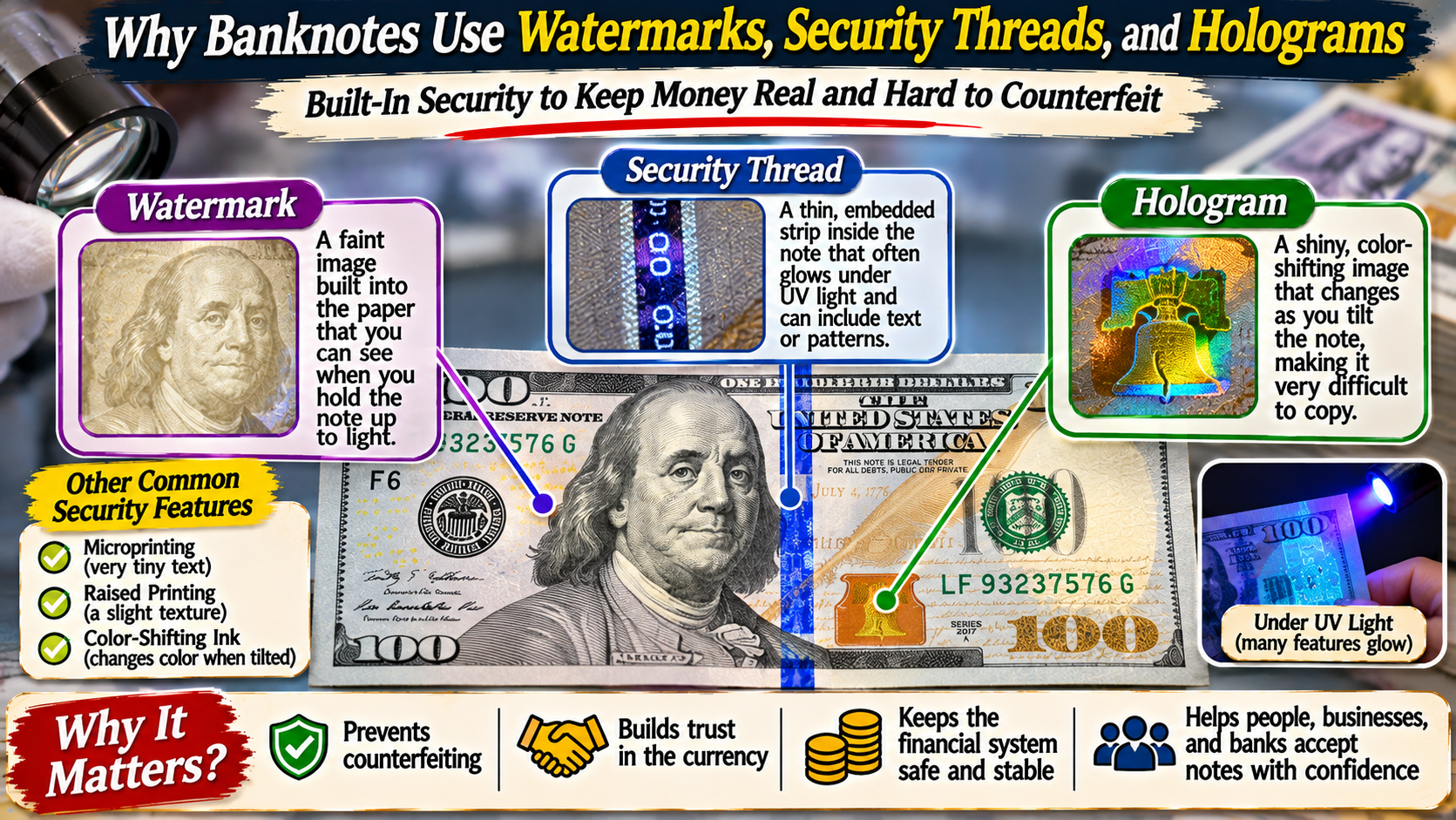
Among the most recognizable are watermarks, security threads, and holograms.
Each works differently, but all serve a common purpose: making genuine banknotes easier to recognize and unauthorized copies harder to reproduce convincingly.
Modern banknote security relies on multiple independent features rather than a single hidden mark.
Understanding these technologies reveals how material science, optics, printing, and manufacturing work together to protect everyday money.
Why Do Banknotes Need Security Features?
Currency must be trusted to function effectively.
When people accept a banknote, they expect it to represent genuine money issued by the appropriate monetary authority.
Counterfeit notes threaten that confidence.
They can cause financial losses for individuals and businesses and create additional costs for banks, retailers, and law-enforcement agencies.
Currency designers therefore use features that are difficult to reproduce with ordinary printing or copying equipment.
Some features are visible to the public.
Others are intended for professional authentication equipment.
A well-designed banknote allows ordinary users to check several characteristics quickly while providing more advanced verification methods for banks and cash-processing systems.
CORE SECURITY PRINCIPLE
One Security Feature Helps. Several Independent Features Protect Better.
Combining different materials, optical effects, and printing methods creates multiple opportunities to distinguish genuine currency from suspicious reproductions.
1. Watermarks: Images Built into the Banknote Material
A watermark is a design that becomes visible when a banknote is held against a light source.
Traditional banknote watermarks are created during the manufacture of specialized paper.
They are not simply pictures printed onto the finished surface.
Instead, variations in the paper’s thickness and fiber distribution create lighter and darker areas when light passes through.
This allows the watermark to display subtle differences in tone.
Portrait watermarks can include fine details and gradual shading.
Because the image is integrated into the paper itself, it behaves differently from a surface-printed imitation.
Why Watermarks Are Useful
Watermarks provide a relatively quick visual check.
In suitable lighting, users can examine the note against the light and compare the watermark with the expected design.
A genuine watermark typically has a more integrated appearance than a picture printed on the surface.
However, the precise appearance varies by currency and denomination.
Not every banknote uses the same watermark technology.
Some modern polymer notes use transparent windows and other optical elements instead of traditional paper watermarks.
SECURITY FEATURE / 01
Watermark
How it works: Differences in paper structure produce a visible image when light passes through.
Typical check: Hold the note up to a light source.
Main benefit: Provides a feature that cannot be convincingly duplicated through ordinary surface printing alone.
2. Security Threads: Embedded Strips Inside the Note
A security thread is a narrow strip incorporated into a banknote during manufacturing.
Depending on the currency, it may be fully embedded or appear intermittently at the surface.
Some threads contain metallic or other specialized materials.
Others include text, patterns, optical effects, or properties that can be detected using appropriate equipment.
When a note is held up to light, an embedded thread may become visible as a continuous line.
Some currencies also use threads that respond to ultraviolet light.
These features provide additional evidence that the note was manufactured using specialized processes.
Why Not Simply Print a Line?
A printed line can resemble a security thread from certain viewing angles.
However, a genuine embedded thread is part of the banknote’s construction.
Its position, optical appearance, and material properties may differ from a superficial imitation.
This distinction makes embedded threads useful for both public inspection and professional verification.
Security-thread designs vary widely across countries and denominations.
Some are intentionally conspicuous, while others become most noticeable under particular lighting conditions.
SECURITY FEATURE / 02
Security Thread
How it works: A specialized strip is incorporated into the banknote substrate.
Typical check: Examine the note against light or follow the issuing authority’s published instructions.
Main benefit: Adds a material-based authentication feature beyond conventional ink printing.
3. Holograms: Images That Change with Viewing Angle
Holographic features are widely associated with modern security documents.
They can create visual effects that change as a note is tilted or moved.
Depending on the design, a reflective element may display shifting images, patterns, or apparent depth.
These effects rely on specialized optical structures that control how light interacts with the surface.
Many banknote security foils use diffractive optical technology.
Although people often refer to all reflective, changing banknote elements as holograms, different optical technologies may be involved.
The important distinction is that these features behave differently under changing viewing conditions.
Why Holographic Features Help
Ordinary printing produces a largely fixed image.
Holographic and related optically variable elements can display changes that depend on viewing angle and illumination.
This makes them useful for quick public inspection.
They also add another manufacturing technology to the banknote.
Some notes combine reflective foils with transparent windows, micro-optical structures, or other specialized effects.
Not every currency uses a conventional hologram, and the expected appearance should always be checked against official information for the specific note.
SECURITY FEATURE / 03
Holographic and Optical Features
How they work: Specialized optical structures create effects that vary with angle or lighting.
Typical check: Tilt the note and observe the expected changes.
Main benefit: Adds visually recognizable effects that ordinary static printing cannot fully reproduce.
Why Different Security Features Work Together
Watermarks, security threads, and holographic features protect banknotes in different ways.
Watermarks depend on the structure of the substrate.
Security threads incorporate specialized material into the note.
Holographic and other optically variable elements rely on the behavior of light.
Because these technologies are fundamentally different, they provide complementary forms of authentication.
Currency designers often combine them with additional printing and material features.
This layered approach helps people perform simple checks while giving banks and professional cash handlers more ways to examine suspicious notes.
Other Important Banknote Security Technologies
Watermarks, threads, and holograms are only part of modern banknote design.
Many currencies include additional features that support recognition and authentication.
Color-Shifting Ink
Some banknotes use ink that changes apparent color when viewed from different angles.
This effect can help users recognize a genuine note without special equipment.
The exact colors and locations vary by currency.
Raised Printing
Some banknotes use specialized printing processes that create a distinctive texture.
Raised printing can be useful when checking a note by touch.
It may also improve accessibility for some users.
Microprinting
Microprinting consists of extremely small text or patterns.
On genuine notes, these details may appear sharp under magnification.
They can be difficult to reproduce accurately with ordinary copying equipment.
Transparent Windows
Polymer banknotes often feature clear windows containing printed or optical elements.
These windows are integrated into the polymer substrate and may contain additional security features.
Ultraviolet-Reactive Features
Some notes contain materials that respond in characteristic ways under ultraviolet illumination.
These features are useful only when interpreted according to the relevant currency’s official specifications.
Paper vs. Polymer Banknotes
Not all banknotes are made from the same material.
Traditional banknote paper is commonly produced from specialized cotton-based fibers rather than ordinary office paper.
Many countries also issue polymer banknotes made from durable plastic-based substrates.
Both materials can support sophisticated security technologies.
However, their manufacturing methods and available design options differ.
Paper notes may incorporate traditional watermarks and embedded threads.
Polymer notes can include transparent windows and integrated optical elements.
Some currencies combine different materials or technologies in hybrid designs.
The choice of substrate involves security, durability, handling, cost, and environmental considerations.
No single substrate guarantees complete protection against counterfeiting.
Banknote Security Features Compared
| Security Feature | Main Technology | Common Public Check |
|---|---|---|
| Watermark | Substrate structure | Hold to light |
| Security thread | Embedded material | Hold to light or inspect as directed |
| Holographic feature | Specialized optics | Tilt the note |
| Color-shifting ink | Optically variable pigments | Tilt the note |
| Raised printing | Specialized printing process | Feel the texture |
| Microprinting | Fine-detail printing | Inspect closely or with magnification |
| Transparent window | Polymer substrate design | Inspect window and optical details |
How People Can Check a Banknote
Many monetary authorities recommend simple public inspection methods.
The exact procedure varies by currency and denomination.
However, several general observations are useful.
PUBLIC AWARENESS / BASIC INSPECTION ROUTINE
Notice the substrate and any raised printing expected on the note.
Check for the expected watermark or embedded thread, if the denomination includes them.
Observe any officially documented color changes or optical effects.
Look for sharp printing and other expected design features.
Use information published by the relevant central bank or currency authority.
These steps are general educational guidance, not a guarantee of authenticity.
A suspicious note should be handled according to the relevant country’s official procedures.
Security Features on U.S. Dollar Banknotes
U.S. currency provides familiar examples of layered banknote security.
Several modern U.S. denominations include portrait watermarks, embedded security threads, and color-shifting ink.
The $100 note includes a distinctive blue 3-D Security Ribbon with visual effects that change as the note is tilted.
This ribbon is a specialized micro-optical feature rather than an ordinary printed blue strip.
U.S. notes also use features such as raised printing and detailed background patterns.
However, not every denomination contains every security feature.
For example, lower denominations differ from higher-value notes in their security designs.
Users should consult official U.S. currency education resources for denomination-specific details.
Official guidance is available through the U.S. Currency Education Program.
Why Banknote Designs Change Over Time
Banknote security is not static.
Issuing authorities periodically update currency designs to improve security, durability, usability, or accessibility.
New technologies may offer better optical effects, improved material properties, or more convenient public verification.
Design changes can also help authorities replace older features that have become less effective.
However, redesigning currency requires careful planning.
New notes must work with cash-handling equipment and remain practical for everyday use.
They must also be recognizable to the public.
Successful currency design balances security with durability, accessibility, manufacturing cost, and ease of authentication.
Can Security Features Completely Prevent Counterfeiting?
No security system can guarantee that counterfeit attempts will disappear entirely.
Instead, banknote security aims to make unauthorized reproduction more difficult, costly, and detectable.
Layered features increase the number of characteristics that must be examined when verifying a note.
They also allow different groups to use different methods of inspection.
Members of the public can check visible and tactile features.
Retailers may use additional equipment.
Banks and specialized cash processors can apply more advanced authentication systems.
Public education remains important because even sophisticated security features are less useful when people do not know how to recognize them.
Frequently Asked Questions
Why do banknotes have watermarks?
Watermarks provide an image integrated into the banknote material, helping people distinguish genuine notes from ordinary printed reproductions.
What is a security thread in a banknote?
It is a specialized strip incorporated into the note during manufacturing. Depending on the design, it may be visible against light or have additional optical properties.
Do all banknotes contain holograms?
No. Security designs differ among currencies and denominations. Some notes use holographic or related optical features, while others use different technologies.
Are watermarks printed onto banknotes?
Traditional paper watermarks are created through variations in the paper structure during manufacturing rather than ordinary surface printing.
Why do some banknote images change color?
Some notes use optically variable inks or other specialized optical elements that change appearance with viewing angle.
Are polymer banknotes more secure than paper notes?
Both can include advanced security features. Overall security depends on the complete design rather than substrate material alone.
What should I do if a banknote looks suspicious?
Consult the issuing authority’s official authentication guidance and follow local procedures for reporting or handling suspected counterfeit currency.
Final Thoughts
Modern banknotes are carefully engineered security documents.
Watermarks use the structure of specialized paper to reveal images under transmitted light.
Security threads incorporate additional materials into the note.
Holographic and related optical features create visual effects that change with viewing conditions.
These technologies work alongside color-shifting inks, microprinting, raised printing, and other protective features.
Their combined purpose is to support confidence in physical currency by making genuine notes easier to recognize and counterfeit notes more difficult to reproduce convincingly.
Although digital payments are increasingly common, physical banknotes remain important in many economies.
Understanding the science behind their security features offers a fascinating look at the intersection of money, manufacturing, materials, and light.
The next time you hold a banknote, remember that its most important details may be the ones you do not notice at first glance.