American Fiscal Heritage: The Transformation of United States Paper Money
From the desperate emergency ‘Greenbacks’ issued by Abraham Lincoln to finance the Civil War to the majestic large-size Gold and Silver Certificates of the Gilded Age, the paper currency of the United States chronicles the rise of an agrarian republic into the world’s preeminent financial superpower.
The pivotal turning point arrived in 1929 with the comprehensive standardization of physical dimensions, portrait protocols, and the centralized establishment of the Federal Reserve Note as America’s universal sovereign tender.
🪙
Part I: Civil War Origins
The Civil War Crisis and the Birth of the First ‘Greenbacks’
Prior to the outbreak of the American Civil War in 1861, the United States federal government did not issue paper money for public circulation. Under the hard-money doctrine inspired by Andrew Jackson, sovereign legal tender was defined strictly by the Constitution as gold and silver coin. Private commerce relied upon a chaotic, unregulated mosaic of over seven thousand distinct banknotes issued by sixteen hundred state-chartered private banks. These state banknotes fluctuated wildly in purchasing power depending upon the geographical distance to the issuing bank, with hundreds of wildcat banks failing regularly and leaving citizens holding worthless paper scrap.
When the Confederate rebellion erupted in April 1861, the Union war effort required staggering fiscal expenditures that instantly overwhelmed the federal treasury’s gold reserves. By December 1861, commercial banks in New York and Boston suspended specie (gold and silver) payments, refusing to redeem paper deposits in gold. Facing imminent military defeat due to bankrupt supply lines, President Abraham Lincoln and Treasury Secretary Salmon P. Chase made an unprecedented constitutional leap by proposing the Legal Tender Act of February 1862.
The Legal Tender Act authorized the United States Treasury to issue $150 million in non-interest-bearing United States Notes (Demand Notes and Legal Tender Notes). Unlike previous treasury paper, these notes were designated as full legal tender for all public and private debts, except import tariffs and interest on the public debt. Struck with vibrant, chemically protective green anti-counterfeiting ink on their reverse faces by the American Bank Note Company and the fledgling Treasury engraving bureau, the public immediately christened them ‘Greenbacks’. While Confederate paper collapsed into hyperinflationary oblivion due to unbacked overprinting, Union Greenbacks fluctuated against gold based on military fortunes, surging toward par after the decisive victories at Gettysburg and Vicksburg and establishing the permanent precedent for direct federal paper currency.
| Currency Classification | Issuing Era | Physical Dimensions | Redemption Guarantee | Iconic Denominations & Portraits |
|---|---|---|---|---|
| Demand Notes / Legal Tender | 1861 – 1862 | 7.375 x 3.125 in (Large-Size) | Fiat credit of the US Government (‘Greenbacks’) | $5 Hamilton / Statue of Freedom; $10 Lincoln; $20 Liberty |
| National Bank Notes | 1863 – 1935 | 7.375 x 3.125 in (Large-Size) | Backed by US Treasury bonds deposited by banks | Custom bank charter names; Battle of Lexington; Columbus |
| Silver Certificates | 1878 – 1964 | Large-Size (pre-1929), Small-Size (post-1929) | Payable to the bearer on demand in silver dollars | $1 Martha Washington; $1 1896 Educational; $5 Chief Onepote |
| Gold Certificates | 1863 – 1934 | Large-Size (pre-1929), Small-Size (post-1929) | Payable to the bearer on demand in gold coin | $20 Saint-Gaudens; $100 Benton; $10,000 Chase; $100,000 Wilson |
| Federal Reserve Bank Notes | 1915 – 1934 | Large-Size & Small-Size variants | Obligations of the 12 individual Reserve Banks | Emergency cash infusions during Great Depression; battleship reverses |
| Small-Size Federal Reserve Notes | 1929 – Present | 6.14 x 2.61 in (Standardized) | Lawful money; sovereign legal tender of USA | $1 Washington; $2 Jefferson; $5 Lincoln; $10 Hamilton; $20 Jackson; $50 Grant; $100 Franklin |
⚖️
Part II: Gilded Age Masterpieces
The Golden Age of American Numismatic Art: The Educational Series and Gold Certificates
The late nineteenth and early twentieth centuries are celebrated by collectors as the Golden Age of American Banknote Engraving. United States currency of this era was printed in the magnificent ‘large-size’ format (measuring approximately 7.375 by 3.125 inches—colloquially termed ‘horse blankets’ due to their substantial physical footprint). During this period, the Bureau of Engraving and Printing (BEP) in Washington, D.C., employed world-renowned artists, illustrators, and master steel engravers to transform currency into monumental allegorical canvases celebrating national unity, technological triumph, and manifest destiny.
The undisputed pinnacle of this artistic renaissance arrived with the Silver Certificates of Series 1896, universally known to numismatists as the Educational Series. Conceived by artist Edwin Blashfield, Will H. Low, and Walter Shirlaw, the one-dollar note featured ‘History Instructing Youth,’ depicting an allegorical winged maiden showing a young boy the United States Constitution against a panoramic backdrop of the Potomac River and Washington Monument, surrounded by wreaths naming American historical luminaries. The two-dollar note depicted ‘Science Presenting Steam and Electricity to Commerce and Manufacture,’ while the breathtaking five-dollar note showcased ‘Electricity as the Dominant Force in the World,’ portraying a winged goddess soaring through storm clouds with an electric bulb, surrounded by allegorical figures of Fame and Progress.
Equally revered were the Gold Certificates issued between 1882 and 1928. Bearing the iconic, radiant golden-orange reverse printing (signifying the gold bullion vaults backing the paper), these large-size notes bore the solemn guarantee: ‘This certifies that there have been deposited in the Treasury of the United States of America [X] Dollars in Gold Coin payable to the bearer on demand.’ Notes such as the 1907 $20 ‘Technicolor’ Gold Certificate, featuring a majestic portrait of George Washington surrounded by golden halos and vermilion treasury seals, represented the absolute zenith of American security printing aesthetics.
🏛️
Part III: The 1929 Revolution
The Great Standardization of 1929: Efficiency, Dimensions, and Unified Portraits
By the mid-1920s, the rapid industrialization of the American economy generated massive transactional volume that rendered the large-size banknote obsolete. Operating dozens of different currency types—National Bank Notes, Silver Certificates, Gold Certificates, Legal Tender Notes, and Federal Reserve Notes—each requiring unique printing plates, distinct paper stocks, and separate accounting ledger entries created severe administrative congestion inside the Treasury Department. Furthermore, large-size notes were expensive to print, consumed vast quantities of linen paper, and wore out quickly in commercial handling.
Under the visionary leadership of Treasury Secretary Andrew W. Mellon, the federal government enacted the historic Currency Standardization of 1929. The reform introduced two fundamental changes that define United States currency to this day. First, physical dimensions were reduced by roughly thirty percent, shrinking from 7.375 x 3.125 inches down to the modern standardized small-size dimensions of 6.14 x 2.61 inches (156 x 66.3 mm). This reduction allowed the Bureau of Engraving and Printing to print twelve notes per paper sheet instead of eight (and later eighteen and thirty-two notes per sheet), saving millions of dollars annually in ink, cotton paper, and shipping weights.
Second, Secretary Mellon established a strict, unvarying portrait hierarchy across all denominations to prevent public confusion. George Washington was permanently assigned to the $1 bill, Thomas Jefferson to the $2, Abraham Lincoln to the $5, Alexander Hamilton (the first Treasury Secretary) to the $10, Andrew Jackson to the $20, Ulysses S. Grant to the $50, and Benjamin Franklin to the $100. High-denomination notes—issued primarily for inter-bank clearing settlements—featured William McKinley on the $500, Grover Cleveland on the $1,000, James Madison on the $5,000, Salmon P. Chase on the $10,000, and Woodrow Wilson on the titanic $100,000 Gold Certificate of 1934.
👑
Part IV: The Modern FRN
The Federal Reserve Act of 1913 and the Death of Specie Backing
The contemporary greenback is officially classified as a Federal Reserve Note (FRN). Created by the landmark Federal Reserve Act of December 23, 1913, under President Woodrow Wilson, the Federal Reserve System established twelve regional Reserve Banks (Boston, New York, Philadelphia, Cleveland, Richmond, Atlanta, Chicago, St. Louis, Minneapolis, Kansas City, Dallas, and San Francisco) to provide an ‘elastic currency’ capable of expanding and contracting in response to agricultural harvests, industrial cycles, and commercial financial panics.
Initially, Federal Reserve Notes were backed by forty percent gold bullion reserves held by the Reserve Banks and commercial paper collateral. However, the catastrophic global deflation of the Great Depression dismantled this gold nexus. On April 5, 1933, President Franklin D. Roosevelt signed Executive Order 6102, which criminalized the private ownership and hoarding of gold coins, gold bullion, and Gold Certificates by American citizens, forcing millions of people to surrender their gold to the Federal Reserve in exchange for paper notes at $20.67 per ounce. The subsequent Gold Reserve Act of 1934 devalued the dollar to $35 per ounce and permanently banned the redemption of circulating paper currency into gold coin.
Thirty years later, escalating global industrial demand for silver forced the elimination of the silver link. In 1963, Congress authorized the issuance of $1 and $2 Federal Reserve Notes, replacing the traditional $1 Silver Certificates. By 1968, the Treasury permanently halted the redemption of Silver Certificates in raw silver granules or silver dollars, cementing the Federal Reserve Note as an unbacked, pure fiat legal tender currency anchored entirely by the sovereign credit and taxing authority of the United States government.
📜
Part V: Contemporary Security Era
Modern High-Tech Redesigns: From the 1996 Big Head to the 2013 Color Series
For more than sixty years following the 1929 standardization, the visual appearance of American currency remained virtually unchanged, characterized by small centered oval portraits, green treasury seals, and intricate border scrollwork. However, the dawn of high-resolution digital scanning, ink-jet printers, and desktop publishing in the early 1990s triggered a worldwide counterfeiting crisis, forcing the Treasury to undertake the most comprehensive redesign in modern American history.
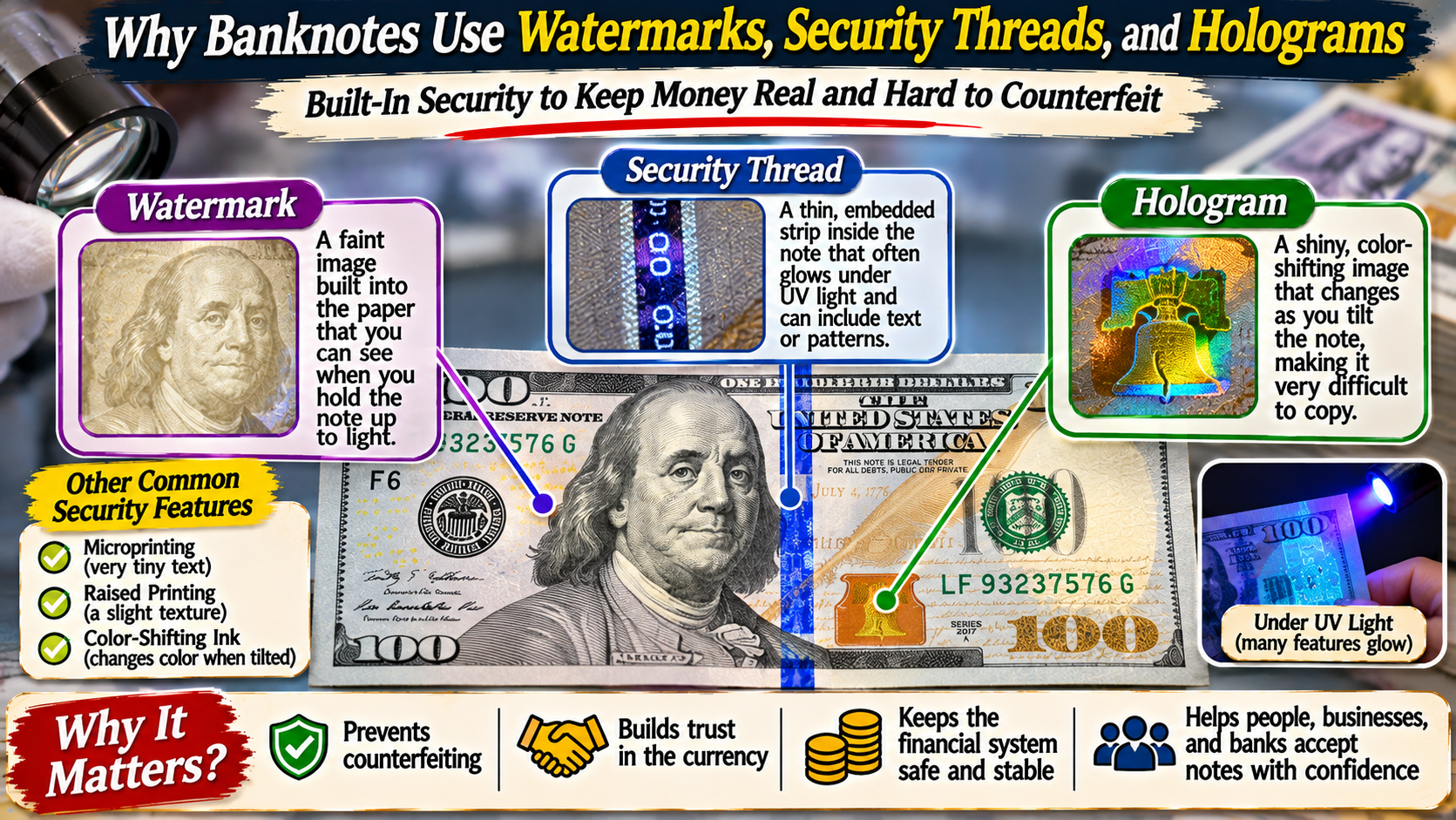
Beginning in 1996 with the new $100 bill, the Treasury introduced the ‘New Currency Design’ (colloquially called the ‘Big Head’ series). Portraits were enlarged and shifted off-center to prevent visual wear along the central vertical fold and make space for a true cylinder-mold watermark on the right. Fine microprinting was added around the portraits, alongside embedded polymer security threads that glowed red under ultraviolet light. A decade later, the Treasury introduced the ‘NextGen’ color series (Series 2004–2013), introducing subtle pastel background tints of yellow, orange, and blue, the iconic 3D Motion security ribbon, and the color-shifting bell in the inkwell on the $100 bill.
Today, the Bureau of Engraving and Printing operates two high-security printing facilities—the historic Washington, D.C. headquarters and the Western Currency Facility in Fort Worth, Texas (identifiable on modern bills by a small ‘FW’ mintmark in the lower-right margin). Producing billions of banknotes annually, the BEP maintains the Federal Reserve Note as the world’s primary global transactional currency and foreign exchange reserve asset, preserving a rich unbroken continuum that links Lincoln’s emergency Civil War Greenbacks to the global financial markets of the twenty-first century.
Key Takeaways: The Federal Reserve Note Evolution
Lincoln’s Greenbacks: The Legal Tender Act of 1862 created direct federal paper money to fund the Union war effort, establishing the historic green-ink tradition.
Gilded Age Masterpieces: Large-size Silver and Gold Certificates of the late 19th century represented the absolute zenith of artistic allegorical engraving and public trust.
The 1929 Standardization: Secretary Andrew Mellon reduced note dimensions by 30% and established the permanent portrait hierarchy from Washington ($1) to Franklin ($100).
The Fiat Transition: Roosevelt’s 1933 gold confiscation and the 1968 end of silver certificate redemption severed physical bullion backing, creating the modern fiat dollar.
The Extinction of High-Denomination Notes: The $500 to $10,000 Bills and the 1969 Ban
While modern Americans are intimately familiar with the $100 bill as the highest circulating denomination, the United States Treasury historically issued colossal high-denomination notes for interbank wire clearings and major real estate transfers. These included the $500 note featuring William McKinley, the $1,000 note honoring Grover Cleveland, the $5,000 note depicting James Madison, and the legendary $10,000 note bearing the portrait of Salmon P. Chase (the Civil War Treasury Secretary who created the Greenback). In 1934, during the depths of the Great Depression, the BEP printed a limited run of the titanic $100,000 Gold Certificate, featuring President Woodrow Wilson, which was never circulated publicly and was used exclusively for gold transfer accounting between Federal Reserve Banks.
By the late 1960s, the rapid adoption of computerized mainframe banking, secure telegraphic money transfers, and automated interbank wire networks rendered physical high-denomination paper notes functionally obsolete for legitimate corporate commerce. Concurrently, federal law enforcement agencies discovered that high-value banknotes were overwhelmingly favored by organized crime syndicates, international drug cartels, and money launderers seeking to transport millions of illicit dollars in compact briefcases. On July 14, 1969, the Department of the Treasury and the Federal Reserve officially halted the distribution of all denominations above $100, ordering commercial banks to return any received high-denomination notes to the Treasury for immediate destruction. Although these legendary notes remain technically legal tender to this day, their numismatic value among collectors far exceeds their face value, with crisp $10,000 bills realizing hundreds of thousands of dollars at public auction.
Furthermore, the Federal Reserve Note continues to serve as the bedrock of international global trade reserves. Despite recurring domestic debates regarding the elimination of the $1 bill in favor of a circulating one-dollar coin (similar to the British pound coin or Canadian loonie), the American public has fiercely defended the paper dollar. The Bureau of Engraving and Printing’s continuous innovations in tactile micro-lettering, high-security infrared-absorbing inks, and multi-spectral security fibers guarantee that the Federal Reserve Note will retain its legendary global status well into the twenty-first century.