High-Security Engineering: The Sovereign Paper Fortress
Modern paper currency is one of the most technologically advanced mass-produced physical artifacts on Earth. Far from ordinary stationery, a modern banknote is a high-security composite substrate engineered to resist industrial counterfeiting, optical scanners, high-resolution digital presses, and extreme mechanical friction.
From the tactile ridges of steel-plate intaglio printing and microscopic colour-shifting inks to biaxially oriented polypropylene (BOPP) polymer windows, the manufacturing of circulating legal tender combines centuries-old master craftsmanship with cutting-edge optical physics.
🪙
Part I: Substrate Chemistry
The Battle of the Substrates: Traditional Cotton-Linen vs. Biaxially Oriented Polymer
At the foundation of every banknote lies its base substrate, the physical canvas that must endure being crumpled into pockets, washed in laundry machines, exposed to tropical humidity, and passed through millions of automated teller machine (ATM) rollers. For over two centuries, the premier global standard has been cotton-linen rag paper. Unlike commercial printing paper derived from wood pulp—which contains lignin that oxidizes, yellows, and becomes brittle within years—banknote paper is manufactured from 75 to 100 percent combed cotton fibers, often blended with 25 percent high-tensile flax or linen (as utilized by the United States Bureau of Engraving and Printing since the late nineteenth century).
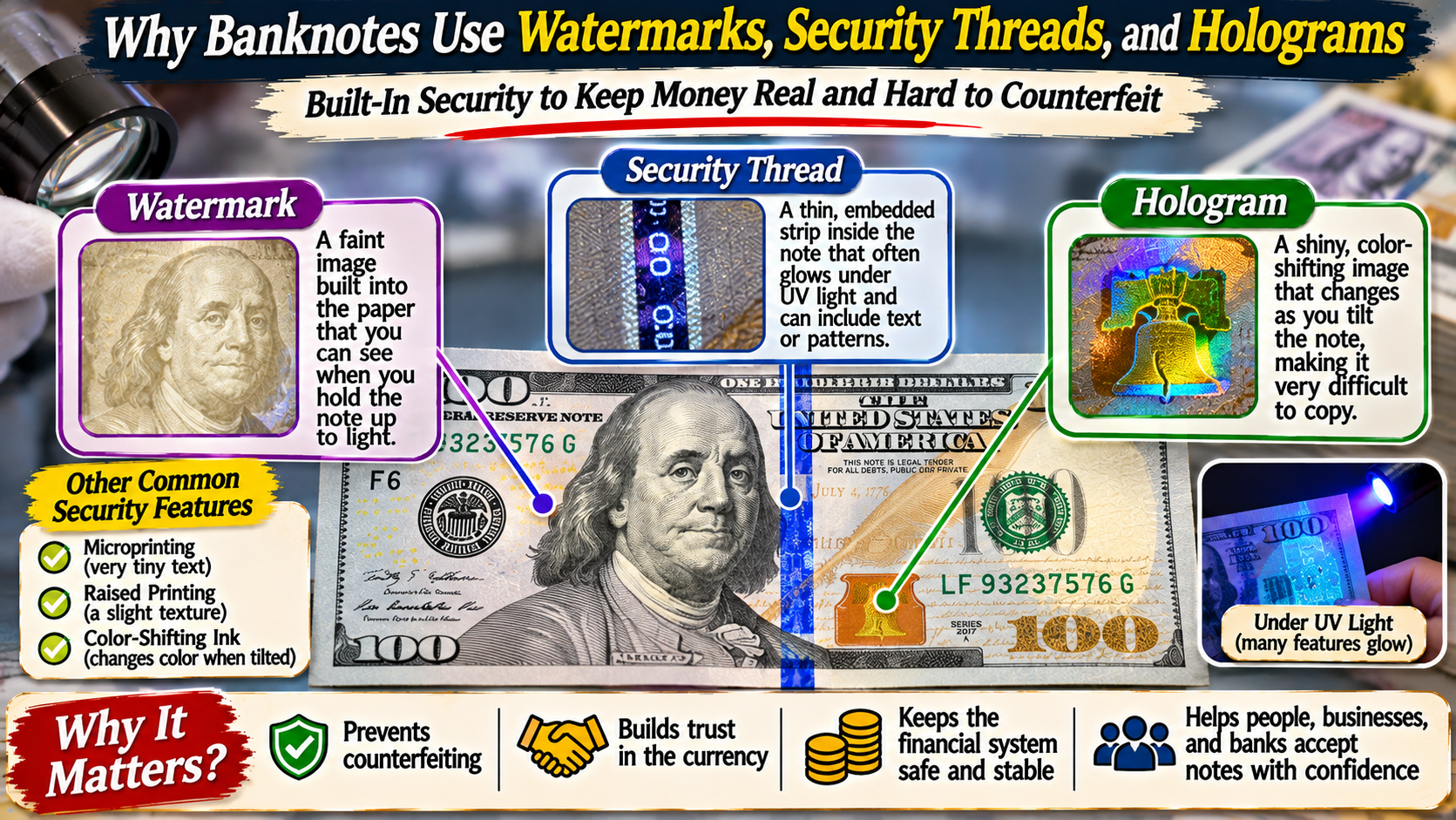
Cotton fibers possess exceptionally long, interlocking cellulose chains that provide remarkable tensile strength, high tear resistance, and a distinctive crisp snap that human fingertips instinctively recognize. During the paper-making process on specialized cylinder-mold machines, security paper manufacturers (such as Crane & Co., De La Rue, and Giesecke+Devrient) embed primary security features directly into the wet pulp slurry before it dries. The most revered of these is the true multi-tone watermark, created by subtle variations in paper thickness caused by raised and recessed patterns on the wire cylinder mold. Because thicker areas block light and appear darker while thinner areas allow light to pass through and appear bright, an authentic watermark reveals delicate three-dimensional tonal shading that cannot be replicated by surface photocopying or desktop digital printing.
In 1988, Australia revolutionized central banking by issuing the world’s first non-fibrous polymer banknote—a commemorative ten-dollar bill developed jointly by the Reserve Bank of Australia (RBA) and the Commonwealth Scientific and Industrial Research Organisation (CSIRO). Commercialized under the brand Guardian by CCL Secure, modern polymer currency is manufactured from biaxially oriented polypropylene (BOPP). The base film begins as a clear, non-porous plastic sheet that is stretched simultaneously in two directions at high temperatures to align its polymer chains, resulting in immense tear resistance, imperviousness to water, oils, and sweat, and an operational lifespan roughly three to four times longer than traditional cotton paper.
To transform the transparent BOPP film into a printable banknote, specialized coating machines apply multiple opaque white ink layers (opacification) to both sides of the sheet, deliberately leaving designated areas completely unprinted to create transparent security windows. These clear windows provide a revolutionary security architecture impossible on traditional paper: central banks can embed complex diffractive optical elements (DOEs), iridescent holographic portraits, and microscopic lenses directly inside the clear plastic window, allowing citizens to verify authenticity simply by looking through the banknote toward any light source.
| Engineering Metric | Cotton-Linen Rag Paper | Biaxially Oriented Polymer (BOPP) | Hybrid Composite Substrate |
|---|---|---|---|
| Base Composition | 75% Cotton, 25% Linen (or 100% Cotton) | Biaxially Oriented Polypropylene (BOPP) | Cotton core with polymer laminate outer skins |
| Average Circulation Lifespan | 1.5 to 2.5 years (low denominations) | 5.0 to 8.0 years (exceptional durability) | 3.5 to 5.0 years (balanced longevity) |
| Water & Soil Resistance | Absorbs sweat, oils, moisture; soils easily | Completely non-porous; wipes clean of liquids | High outer barrier protection against dirt and moisture |
| Tactile Signature | Crisp paper snap, distinct fibrous rough feel | Smooth plastic texture; unique polymer bend recoil | Retains classic paper feel with polymer resilience |
| Primary Security Integration | Embedded multi-tone cylinder watermarks, threads | Transparent windows, micro-lenses, diffractive foils | Combination of watermarks and windowed film slots |
| Environmental End-of-Life | Shredded and composted or incinerated | Granulated, melted, and recycled into plastic products | Downcycled through industrial thermal recovery |
| Primary Global Adopters | United States (Federal Reserve), Eurozone, Japan | United Kingdom, Canada, Australia, New Zealand | Switzerland (Durasafe), Bulgaria, select African nations |
⚖️
Part II: Printing Technology
The Tactile Fortress: Steel-Plate Intaglio Engraving and Guilloche Geometry
The premier security defense of any circulating banknote is tactile relief created by intaglio printing. Developed during the Renaissance as a fine art engraving technique, industrial banknote intaglio involves etching microscopic grooves into hardened nickel and steel plates using diamond cutters, high-precision lasers, and chemical acids. Master engravers spend months painstakingly cutting the sovereign portrait hair by hair, crosshatching shadows to achieve photorealistic depth. In the printing press, these etched steel plates are loaded with thick, viscous paste inks, wiped clean so ink remains only inside the recessed grooves, and brought into contact with the substrate under colossal hydraulic pressure exceeding twenty to thirty tons per square inch.
This tremendous compressive force forces the paper or polymer into the microscopic steel grooves, physically embossing the substrate and transferring thick, raised ridges of ink onto the surface. When a visually impaired individual or bank cashier runs a fingernail across the central portrait, national bank title, or denomination numerals, they feel an unmistakable raised, tactile texture that flat digital offset presses, commercial laser printers, and color copiers cannot replicate. Flat modern counterfeiters can duplicate the visual colors of a bill, but their reproductions feel completely smooth and dead to the touch, failing the primary human tactile test.
Surrounding the intaglio portrait are hypnotic, swirling geometrical background patterns known as guilloche rosettes. Generated through complex mathematical harmonic equations originally produced by mechanical geometric lathes, guilloche lines consist of continuous, unbroken ribbons of contrasting colors that weave in and out of each other without ever touching or smudging. Because digital scanners break continuous images into discrete square pixels (rasterization), attempting to scan and print guilloche patterns introduces severe optical interference known as moiré patterns—distorted rainbow banding and jagged pixel artifacts that expose the fake to even an untrained eye.
🏛️
Part III: Overt Security Features
Micro-Optic Marvels: Motion Threads, SPARK Inks, and Color Shifting
In the contemporary numismatic defense landscape, overt security features—elements that require no specialized UV lights, magnifying glasses, or electronic scanners—are paramount. The most striking optical innovation of the twenty-first century is the integration of micro-optic security threads, popularized by Crane Currency’s MOTION technology, celebrated worldwide on the redesigned United States one-hundred-dollar bill (introduced in 2013). This wide, vivid blue ribbon woven through the cotton paper contains hundreds of thousands of microscopic glass-like lenses positioned above arrayed micro-images. When the bill is tilted horizontally or vertically, optical moiré magnification causes the micro-images (such as Liberty Bells and numeral 100s) to dynamically float across the ribbon in the opposite direction of the tilt, creating a mesmerizing 3D illusion of depth.
Equally sophisticated is the deployment of optically variable inks, specifically the proprietary SPARK technology developed by Swiss security company SICPA. Applied via screen printing, SPARK ink contains microscopic magnetic flakes suspended within a transparent liquid carrier. As the freshly printed banknote passes through a controlled magnetic field, the microscopic flakes orient themselves along curved magnetic lines before the ink is instantly cured with ultraviolet radiation. The resulting visual device—such as the green-to-blue shimmering bell inside the copper inkwell on the US $100 bill or the rolling emerald numerals on the Euro Europa series—displays a brilliant moving bar of light that glides across the numeral as the bill is rotated under ambient light, alongside a dramatic shifting of colors across the electromagnetic spectrum.
Further reinforcing the perimeter are diffractive optical variable image devices (DOVIDs) and micro-holograms. Applied as hot-stamped metallic foils or embedded within polymer windows, these nanoscale diffraction gratings split white light into spectral rainbows, projecting moving 3D animations, holographic state coats of arms, and kinetic color transitions that shift dynamically between horizontal and vertical viewing angles, rendering color photocopying completely futile.
👑
Part IV: Covert Defenses
Covert and Forensic Defenses: The Invisible Guardians of Central Banks
While overt features protect common citizens buying groceries in retail markets, central banks and commercial banking sorting centers rely upon an array of covert and forensic security layers invisible to the naked eye. At the covert level, security printers incorporate specialized ultraviolet (UV) and infrared (IR) reactive pigments into offset and intaglio inks. Under standard 365-nanometer blacklight illumination, areas of a genuine banknote that appear entirely blank under daylight suddenly fluoresce with brilliant yellow, green, red, or blue patterns, such as the glowing vertical security thread on US banknotes or the vibrant constellation of stars on Euro notes.
Under infrared examination, banknotes exhibit sophisticated metameric ink pairs: two inks that appear completely identical in color under ambient sunlight behave radically differently under infrared light wavelengths, with one ink absorbing IR radiation and appearing deep black while the other reflects IR and vanishes entirely from camera sensors. Automated high-speed bank-sorting machines process up to forty banknotes per second, utilizing high-speed infrared cameras, magnetic flux sensors (which detect the precise magnetic signature of iron oxide particles suspended inside black intaglio ink), and thickness gauges to verify authenticity and weed out counterfeit attempts before currency re-enters public circulation.
At the deepest forensic tier—reserved for central bank laboratories and federal secret service investigators—banknotes incorporate proprietary taggant chemicals and machine-readable markers (M-Feature). These specialized chemical isotopes and crystalline phosphors possess unique excitation and decay lifetimes measurable only through calibrated laboratory spectrofluorometers. Even if an illicit nation-state counterfeiter possesses identical paper, ink, and intaglio printing presses, they cannot replicate the proprietary forensic taggant signature embedded by sovereign central banks.
📜
Part V: Digital Security
Digital Anti-Counterfeiting: The EURion Constellation and Machine Intelligence
With the explosive growth of desktop color scanners, image editing software (such as Adobe Photoshop), and photographic laser copiers in the late 1990s, central banks recognized that physical security on the paper was insufficient; security had to be embedded into the digital software algorithms of computers and imaging hardware. To achieve this, the Central Bank Counterfeit Deterrence Group (CBCDG)—an international consortium comprising more than thirty-five central banks—developed the Counterfeit Deterrence System (CDS), alongside the famous EURion constellation.
The EURion constellation consists of a subtle geometric pattern of five small yellow, green, or orange circles (measuring roughly 1 millimeter in diameter) arranged in a precise mathematical constellation resembling the Orion star cluster, repeated across background fields of modern banknotes. When consumer scanning devices, digital cameras, or image editing software detect this specific spatial configuration of five circles, embedded firmware or application software triggers an automatic safety lockout. Programs like Photoshop immediately halt the import command, displaying a warning dialogue informing the user that the software does not support the processing of sovereign banknote imagery and directing them to official central bank regulations.
Looking into the future, modern banknote architecture continues to evolve at the intersection of nanotechnology and automated machine learning. Hybrid composite substrates—such as Landqart’s Durasafe, which sandwiches a clear polymer core between two thin layers of high-grade cotton paper—combine the warm, traditional tactile luxury of paper with the indestructible clear-window capabilities of polymer. As the physical banknote enters its fourth century of global circulation, it remains an extraordinary testament to human ingenuity: a pocket-sized masterpiece of engineering that transforms sovereign credit into an indestructible physical guarantee.
Key Takeaways: Modern Banknote Architecture
Substrate Engineering: Modern banknotes utilize 100% cotton-linen blends with cylinder-mold watermarks, or biaxially oriented polypropylene (BOPP) polymer with clear see-through windows.
Tactile Intaglio Relief: Extreme hydraulic printing pressure embosses thick paste ink into paper, creating raised, tactile ridges that flat counterfeit presses cannot replicate.
Micro-Optic Innovations: Breakthrough overt defenses like Crane’s MOTION lens arrays and SICPA’s magnetic SPARK inks create floating 3D depth and dynamic color shifts.
Invisible Digital Shields: Covert UV/IR fluorescent taggants, magnetic ink profiles, and the EURion constellation prevent automated color scanners and Photoshop from copying currency.
Banknote Destruction, Lifecycle Analytics, and Eco-Friendly Recycling
The lifecycle of a modern banknote does not terminate in a commercial cash register; it ends in the high-speed sorting vaults of national central banks. Every day, millions of circulating notes returned by commercial banks pass through automated banknote processing systems (BPS) manufactured by security engineering leaders such as Giesecke+Devrient. These industrial machines inspect individual banknotes at speeds exceeding forty bills per second, utilizing laser optical sensors, thickness gauges, and acoustic microphones to evaluate soil levels, tape tears, limpness, and ink wear. Notes that pass quality thresholds are bundled and returned to circulation, while soiled, torn, or graffiti-damaged notes are instantly flagged as unfit and routed into high-speed mechanical shredders.
Historically, shredded cotton-linen banknotes were disposed of in municipal landfills or burned in municipal incinerators. However, modern environmental sustainability protocols have transformed banknote disposal into a circular green economy. In the United States, the Federal Reserve shreds approximately five thousand tons of unfit currency annually, recycling the cotton-linen shreds into commercial compost, agricultural fertilizer, and industrial thermal insulation blocks. For polymer banknotes, the recycling process is even more environmentally elegant: unfit BOPP polymer notes are granulated into microscopic plastic pellets, melted down in industrial extruders, and remolded into durable consumer goods such as storage containers, compost bins, railway ties, and commercial building materials, ensuring zero waste sent to landfills.