Monetary Integration: The Audacious Creation of a Borderless Continental Currency
On January 1, 2002, the European Union executed the most colossal physical currency transition in world history: overnight, twelve sovereign nations retired their centuries-old national currencies—including the French Franc, German Deutsche Mark, and Italian Lira—and adopted the Euro.
Engineered to symbolize transnational unity without inflaming nationalistic rivalries, the Euro’s unique architectural design by Robert Kalina and the centralized oversight of the European Central Bank (ECB) represent a monumental triumph of modern numismatic diplomacy.
🪙
Part I: Geopolitical Origins
The Road to Maastricht: Historical Origins of European Monetary Union
The intellectual concept of a unified European currency was born out of the catastrophic wreckage of the Second World War. Visionary statesmen like Jean Monnet, Robert Schuman, and Konrad Adenauer recognized that recurring European conflicts were fundamentally rooted in economic fragmentation, competitive currency devaluations, and aggressive trade protectionism. Following the collapse of the Bretton Woods fixed-exchange system in 1971, European economies suffered chronic currency volatility, with the stable German Deutsche Mark repeatedly appreciating against weaker southern European currencies, disrupting intra-European trade and agricultural pricing.
The definitive milestone on the road to monetary integration was the Werner Report of 1970, followed by the establishment of the European Monetary System (EMS) and the Exchange Rate Mechanism (ERM) in 1979, which pegged European currencies within narrow fluctuation bands relative to an artificial accounting basket known as the European Currency Unit (ECU). However, the true geopolitical catalyst occurred in 1989 with the fall of the Berlin Wall and the reunification of Germany. French President François Mitterrand and German Chancellor Helmut Kohl struck an historic grand bargain: France agreed to support German reunification in exchange for Germany surrendering its beloved Deutsche Mark and binding its immense economic power to a shared European monetary union.
This grand vision was codified in the historic Maastricht Treaty, signed in the Netherlands in February 1992. The treaty established strict economic convergence criteria that candidate nations were required to fulfill before entering the Eurozone: inflation rates no more than 1.5 percentage points above the average of the three lowest-inflation member states; annual government budget deficits not exceeding 3 percent of Gross Domestic Product (GDP); gross public debt capped at 60 percent of GDP; long-term interest rates restrained; and participation in the ERM for at least two years without severe exchange rate devaluation.
| Denomination | Physical Dimensions | Dominant Color Palette | Architectural Era Represented | Symbolic Structural Metaphor |
|---|---|---|---|---|
| €5 Banknote | 120 x 62 mm | Grey (Neutral Stone) | Classical Antiquity (Greek & Roman) | Tuscan / Doric archways; Roman aqueduct spans |
| €10 Banknote | 127 x 67 mm | Red / Terracotta | Romanesque Era (11th – 12th Century) | Heavy semicircular stone arches; monastic bridge pillars |
| €20 Banknote | 133 x 72 mm | Blue (Mediterranean Azure) | Gothic Architecture (13th – 14th Century) | Pointed lancet windows; ribbed flying buttresses; stained glass |
| €50 Banknote | 140 x 77 mm | Orange / Ochre | Renaissance Era (15th – 16th Century) | Harmonious classical proportions; Palladian villa bridges |
| €100 Banknote | 147 x 82 mm (Series 1), 147 x 77 mm (Europa) | Green (Forest / Emerald) | Baroque & Rococo (17th – 18th Century) | Elaborate sculpted pediments; dynamic curving bridge arches |
| €200 Banknote | 153 x 82 mm (Series 1), 153 x 77 mm (Europa) | Yellow-Brown / Golden | Age of Iron & Glass (19th Century) | Industrial wrought iron spans; railway arch bridges; glass skylights |
| €500 Banknote (Discontinued) | 160 x 82 mm | Purple / Violet | Modern 20th Century Architecture | Suspension cables; steel-reinforced concrete cable-stayed bridges |
⚖️
Part II: The Architectural Concept
The Kalina Design Paradigm: Bridges, Windows, and the Diplomacy of Neutrality
When the European Monetary Institute (EMI)—the precursor to the European Central Bank—launched a Europe-wide competition in 1996 to design the visual appearance of the new currency, it faced an unprecedented diplomatic and psychological minefield. For centuries, sovereign banknotes had been dominated by portraits of national heroes: kings, military conquerors, revolutionary statesmen, and poets. If the Euro featured famous historical individuals, how could the EU select figures without provoking bitter nationalist jealousy? If Napoleon Bonaparte was placed on a bill, Britain and Germany would be outraged; if Bismarck was featured, France would object.
The winning design, crafted by Austrian master banknote artist Robert Kalina of the Oesterreichische Nationalbank, solved this dilemma through brilliant metaphorical abstraction. Kalina eliminated all human portraits entirely, replacing them with a narrative of European architectural history spanning two millennia across seven distinct historical epochs: Classical, Romanesque, Gothic, Renaissance, Baroque, the Iron and Glass Industrial Era, and Modern Architecture.
Furthermore, Kalina formulated a profound structural symbolism: on the obverse face of each banknote, he illustrated windows and gateways, symbolizing the European spirit of openness, transparency, and cooperation with the world. On the reverse face, he illustrated bridges, symbolizing the physical connection between European nations and the harmonious linking of Europe with the rest of the globe. Crucially, none of the windows, gateways, or bridges depicted on Euro banknotes correspond to real, physical structures! Every single arch, aqueduct, cathedral window, and suspension bridge was an idealized, generic synthesis created by Kalina to embody the architectural style of the era without representing any specific European bridge in Paris, Rome, London, or Berlin.
🏛️
Part III: The Big Bang Migration
The Physical Big Bang: The 2002 Currency Conversion Logistics
Although the Euro was officially introduced as an electronic and accounting currency on January 1, 1999 (used by commercial banks, bond markets, and stock exchanges across the initial eleven member states), the physical launch on January 1, 2002—christened the ‘Euro Big Bang’—was a logistical operation without precedent in human history. Printing presses across fifteen specialized high-security mints manufactured over fourteen billion banknotes (worth 633 billion euros) and fifty billion coins (worth 16 billion euros), consuming tens of thousands of tons of cotton paper and precious minting alloys.
To prevent economic paralysis on New Year’s Day 2002, the Eurosystem executed a colossal pre-distribution strategy known as ‘frontloading’. Months prior to launch, armored vehicle convoys guarded by military police distributed billions in banknotes to commercial banks, post offices, and major retail conglomerates. In December 2001, millions of pre-packaged coin ‘starter kits’—containing small assortments of euro coins in plastic blister packs—were distributed to the general public to familiarize citizens with the new weights and denominations.
In commercial retail outlets, automatic dual-pricing displayed prices simultaneously in national currencies and Euros to prevent price gouging. A strict two-month dual-circulation window was enforced, during which citizens could pay in their old national currencies (such as French Francs, Spanish Pesetas, or Italian Lire) but received their change exclusively in Euros, smoothly pulling the old legacy money out of circulation. By March 1, 2002, the old currencies ceased to be legal tender, completing the smooth monetary migration of over three hundred million citizens across twelve sovereign nations in less than sixty days.
👑
Part IV: Security Evolution
The Europa Series: Next-Generation Anti-Counterfeiting Engineering
A decade after the initial launch, the European Central Bank under President Mario Draghi launched the comprehensive Europa Series (Series 2) of banknotes, rolled out sequentially between 2013 and 2019. While preserving Robert Kalina’s core architectural themes and color schemes, the Europa series incorporated revolutionary security enhancements. For the first time, a human face was introduced into the Euro design—not a historical politician, but Princess Europa, a figure from Greek mythology representing the mother of the continent, whose portrait was adapted from a 2,000-year-old painted ceramic vase preserved in the Louvre Museum in Paris.
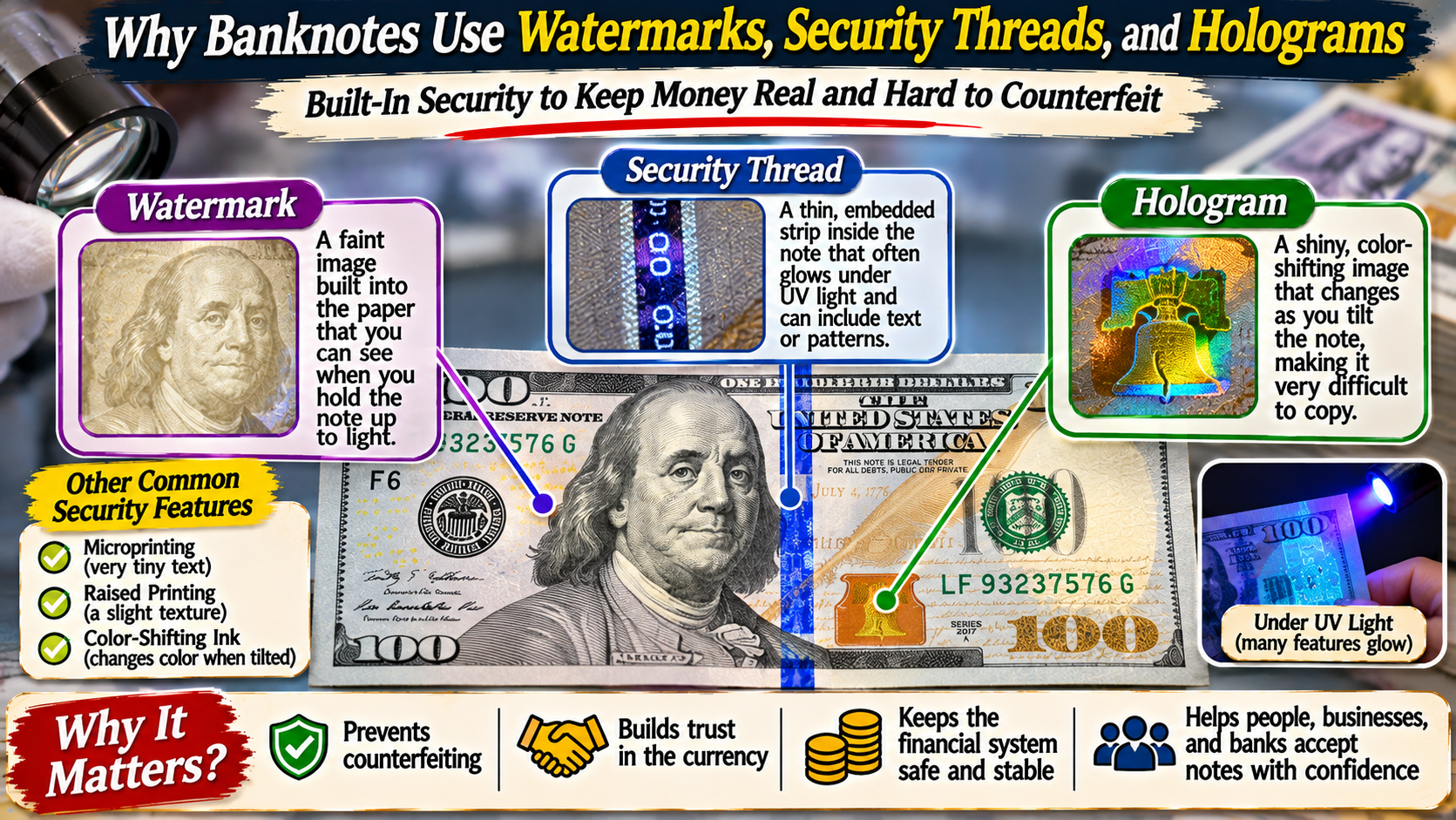
The Europa series introduced the ‘Portrait Window’ in the €20, €50, €100, and €200 notes. Positioned inside the metallic hologram stripe on the right side of the bill, the window becomes completely transparent when held up to the light, revealing a photorealistic portrait of Princess Europa that is visible from both the front and back of the note. Simultaneously, the large emerald numeral in the lower left corner utilizes SICPA’s SPARK technology, displaying a brilliant rolling bar of light moving vertically across the numeral as the bill is tilted, changing color from vibrant emerald green to deep royal blue.
In 2016, the ECB Governing Council made the historic decision to permanently halt the production and issuance of the €500 banknote. While remaining legal tender and retaining its value indefinitely, the €500 note had earned a notorious international reputation among law enforcement agencies (colloquially termed ‘the Bin Laden’ due to its rarity in ordinary commerce and ubiquitous use in illicit trade). Its extraordinary physical value-density—allowing a million euros to be packed into a small cereal box weighing just four pounds—made it an attractive tool for money laundering, terrorism financing, and tax evasion, prompting the ECB to phase it out in favor of the €100 and €200 denominations.
📜
Part V: National Coinage Synergy
Dual Identity: The Bimetallic Euro Coinage System
While Euro banknotes are strictly uniform across all member states, the Euro coinage system reflects an ingenious constitutional compromise between supranational unity and national identity. Struck in eight denominations (1, 2, 5, 10, 20, 50 cents, and 1 and 2 euros), every euro coin possesses a common, standardized European obverse designed by Luc Luycx of the Royal Belgian Mint. These common faces depict stylized geographical maps of Europe, highlighting the political and geographical integration of member nations, framed by the twelve stars of the European flag.
Conversely, the reverse of each euro coin is entirely national, designed by the specific issuing member state. France depicts the iconic figure of Marianne and the Tree of Liberty; Germany showcases the traditional federal eagle and the Brandenburg Gate; Italy celebrates its monumental artistic heritage with Leonardo da Vinci’s Vitruvian Man and Botticelli’s Birth of Venus; Ireland displays the traditional Celtic Brian Boru harp; and Greece proudly features the classical 5th-century BCE Athenian Owl tetradrachm on its 1-euro piece. Despite their differing national reverses, every euro coin is full legal tender in any Eurozone nation, allowing an Italian citizen in Rome to buy coffee with a coin struck in Dublin or Helsinki.
Today, the Eurozone encompasses twenty sovereign member states comprising more than three hundred and fifty million people, with nations like Croatia joining in 2023 and Bulgaria advancing toward accession. As the second most traded currency in the world and the premier competitor to the United States dollar in global foreign exchange reserves, the Euro stands as living proof that sovereign nations can successfully transcend historical rivalries through the architecture of a shared, trustworthy currency.
Key Takeaways: The Euro Architecture
The Maastricht Foundation: The 1992 treaty set strict economic convergence rules that united European economies following the fall of the Berlin Wall.
Kalina’s Architectural Neutrality: Banknotes feature idealized, fictional windows (openness) and bridges (connection) across seven historical architectural epochs, avoiding national portraits.
The 2002 Big Bang: Overnight physical transition retired 12 historic national currencies, distributing billions in banknotes and starter coin kits across 300 million citizens.
The Europa Series Defense: Incorporating the mythological Princess Europa in clear transparent windows, SPARK emerald numbers, and phasing out the high-risk €500 note.
The Third Euro Banknote Series: Public Consultations on Future Continental Themes
As the Euro celebrates over two decades of physical circulation, the European Central Bank has initiated the design process for the next generation: the Third Euro Banknote Series (Series 3), scheduled for phased introduction in the late 2020s. Recognizing that the original architectural bridges and windows concept of Robert Kalina—while masterfully diplomatic—lacked emotional resonance for younger generations of European citizens who grew up knowing only the Euro, the ECB Governing Council launched an unprecedented public consultation process across all twenty member nations.
Hundreds of thousands of European citizens participated in public surveys, leading the ECB to select two shortlisted overarching design themes: ‘European Culture’ and ‘Rivers and Birds.’ The ‘European Culture’ theme explores shared European artistic, scientific, and philosophical heritage, celebrating spaces of collective human creativity such as open-air music theatres, historic university libraries, and monumental architectural squares. The ‘Rivers and Birds’ theme embraces Europe’s biodiversity and interconnected natural ecology, using major trans-European waterways (such as the Danube and Rhine) and migratory wildlife to symbolize the borderless fluidity and environmental stewardship of the continent.
In terms of security architecture, the upcoming third series will integrate next-generation nanophotonic devices, advanced tactile surfaces for the visually impaired, and environmentally sustainable organic cotton substrates treated with bio-based protective varnishes to further reduce carbon emissions. The Euro’s continuing evolution proves that a transnational currency is not a static monetary monument, but a living, dynamic institution that continuously reflects the collective aspirations, ecological values, and technological prowess of hundreds of millions of citizens.