Industrial Sculpture: The Miniature Architecture of Coin Engraving
Coin engraving is one of the most demanding, specialized disciplines in the visual arts. Operating within physical tolerances measured in thousandths of a millimeter and relief heights scarcely thicker than a human fingernail, the coin engraver must transform monumental classical sculpture into durable, mass-producible steel dies.
From hand-chiseled Renaissance punches and the revolutionary Janvier reducing pantograph to contemporary multi-axis CNC lasers and 150-ton hydraulic striking presses, this guide explores the complete mechanical and metallurgical journey from artist’s clay model to circulating coin.
🪙
Part I: Bas-Relief Physics
The Physical Constraints of Bas-Relief Sculpting for Circulating Coinage
A coin is not a miniature freestanding sculpture; it is an industrial tool that must stack uniformly in commercial counting machines, slide effortlessly through automated vending machine coin-mechanisms, and endure decades of violent abrasive friction without having its delicate features worn smooth. These rigorous commercial demands impose strict physical and artistic constraints upon the coin designer known as the physics of ultra-low bas-relief (basso-rilievo).
When an artist sculpts a monumental marble bust or life-sized bronze statue, they possess unlimited depth—a human nose can project several inches forward from the plane of the face, casting natural deep shadows. In stark contrast, a coin engraver working on a modern quarter, euro, or sovereign operates within a maximum relief depth typically ranging between 0.15 and 0.35 millimeters. To create the optical illusion of three-dimensional anatomical volume, muscular tension, and flowing drapery within this microscopic vertical envelope, the artist must master the subtle compression of planes.
Every anatomical contour must be mathematically foreshortened. If an engraver cuts an eyelid, cheekbone, or jawline with vertical, perpendicular 90-degree draft angles, the coin planchet will seize inside the steel die cavity under the immense pressure of the coining press, shattering the die or tearing the newly struck coin upon ejection. Therefore, every relief cavity must possess a delicate draft angle—typically between five and ten degrees—allowing the displaced metal to flow smoothly across the die cavity and release cleanly without friction.
Furthermore, the sculptor must maintain perfect balance between the obverse and reverse designs. If a high-relief portrait of a monarch on the obverse is positioned directly opposite a massive, high-relief heraldic eagle on the reverse, the coining press will suffer from incomplete metal displacement: the cold metal planchet will resist flowing into both deep opposing cavities simultaneously, resulting in a weak, ghostly strike known to numismatists as ‘flatness of strike’ or ‘softness of detail’ across the central devices.
| Tooling Stage | Physical Medium & Scale | Image Orientation | Relief Status | Primary Engineering Function |
|---|---|---|---|---|
| Artist Plaster Model | Plaster of Paris / Plasticine (8–12 inch disc) | Positive (Reads normally) | High sculptural relief (sculpted by hand) | Initial artistic sculpting, lettering layout, anatomical detailing |
| Galvano (Electrotype) | Hard copper shell backed by lead/epoxy | Positive (Reads normally) | High relief (exact copper replica of plaster) | Rigid physical scanning template for the mechanical pantograph tracer |
| Master Die | Tough, annealed carbon-chromium tool steel | Negative (Mirrored / incuse) | Incuse cavity (matches final coin depth) | Cut by pantograph reducing lathe; hand-finished by master engraver |
| Master Hub | Hardened alloy tool steel (quenched & tempered) | Positive (Reads normally) | Raised relief (exact replica of final coin) | Squeezed into soft steel blanks to produce multiple working dies |
| Working Dies | High-grade hardened steel (carbide-reinforced) | Negative (Mirrored / incuse) | Incuse cavity | Mounted inside high-speed coining presses to strike circulating planchets |
⚖️
Part II: The Traditional Workflow
The Traditional Sculpting Workflow: From Sketch to Galvano
For over two centuries, the definitive workflow of official government mints—including the United States Mint, the British Royal Mint, and the Monnaie de Paris—followed an exacting multi-stage classical progression. The process began with detailed two-dimensional graphite sketches exploring composition, typography, heraldic symbols, and historical themes. Once approved by citizen coin advisory committees and government treasury secretaries, the design transitioned into three dimensions.
Working on a circular slate or glass board measuring roughly eight to twelve inches in diameter (roughly six to eight times the scale of the final coin), the sculptor built up the relief layer by layer using oil-based sculpting clay (plastilina). Working at this substantial physical scale allowed the artist to refine micro-details that would be physically impossible to sculpt directly onto a one-inch steel die: the individual hairs of a beard, the microscopic feather barbules of an eagle’s wing, the intricate folds of classical drapery, and the razor-sharp serifs of Roman capital lettering.
Once perfected, liquid plaster of Paris was poured over the clay model to create a negative plaster cast, which was meticulously retouched with fine scrapers to remove air bubbles and tooling blemishes. A positive plaster cast was subsequently poured from the negative. To transform this delicate, fragile plaster into an industrial mechanical scanning template capable of withstanding the diamond-tipped stylus of a reducing lathe, the plaster underwent an electrolytic process to create a galvano: an exact, heavy copper electrotype shell created by immersing the plaster in an acidic copper sulfate bath under an electrical current, subsequently reinforced with a backing of molten lead, bismuth, or modern aerospace epoxy.
🏛️
Part III: The Janvier Pantograph
The Reducing Lathe Revolution: The Genius of the Janvier Pantograph
Before the nineteenth century, transferring an artist’s large-scale sculpture onto a miniature steel coin die required heroic, almost superhuman manual labor: master die sinkers had to hand-engrave the steel die directly at actual 1:1 coin scale using hardened steel burins, diamond gravers, and magnifying glasses. A single mistake could ruin weeks of labor, and identical duplicate dies were virtually impossible to produce, leading to countless minor die varieties across early coin issues.
This manual bottleneck was permanently eliminated by one of the most brilliant mechanical inventions of the Industrial Revolution: the three-dimensional reducing lathe, invented by French engineer Achille Collas in 1836 and perfected into the legendary Janvier reducing machine by Victor Janvier in 1899. The Janvier pantograph operated on an ingenious principle of linked mechanical levers and synchronized rotating spindles. The large copper galvano was mounted on one rotating faceplate, while a soft, annealed tool-steel blank was mounted on a parallel rotating spindle.
A rounded, polished ruby or sapphire tracer slowly scanned the surface of the rotating galvano from the outer rim inward toward the center, moving back and forth like a phonograph needle. A rigid mechanical lever connected this tracer to an ultra-hard, triangular carbide cutting tool that moved simultaneously against the rotating steel blank. Through the geometry of the lever arms, the cutting tool moved through the exact same spatial motions as the tracer, but mathematically reduced down to the exact coin scale (such as 1:6 or 1:8 ratio). Over the course of forty to eighty continuous hours of slow, high-precision carving lubricated by cooling oils, the Janvier lathe carved an exact, microscopic bas-relief replica of the artist’s original plaster model into solid tool steel, creating the master die with sub-micron fidelity.
👑
Part IV: The Tooling Pyramid
The Tooling Pyramid: Master Hubs, Working Dies, and Hydraulic Squeezing
In modern industrial minting operations producing billions of circulating coins annually, a coining die is a consumable tool. Under the immense impact stress of striking hundreds of hard metal planchets per minute, steel dies suffer from microscopic crystal fatigue, die cracks, surface erosion, and edge chipping, typically requiring replacement after fifty thousand to two hundred and fifty thousand strikes. To mass-produce thousands of identical working dies without requiring the artist to sculpt new models, mints utilize an industrial hierarchy known as the Tooling Pyramid.
The master die carved by the reducing lathe (or modern multi-axis laser) is a negative—meaning its features are incuse (recessed into the steel), mirroring the final coin. Because this master die is an invaluable original artwork, it is never used to strike coins. Instead, the master die is placed inside a colossal hydraulic hubbing press capable of delivering hundreds of tons of pressure. A cone-shaped cylinder of softened, annealed tool steel is forced into the master die. Under immense cold plastic deformation, the steel blank absorbs the recessed image, creating a positive master hub (where the design stands up in raised relief, reading normally).
This master hub is subsequently hardened through high-temperature vacuum furnaces and oil quenching. The hardened master hub is then squeezed into additional annealed steel blanks to produce multiple master dies, which in turn are squeezed to create working hubs, which finally squeeze thousands of individual working dies (negatives). Modern CNC hubbing presses utilize computer-controlled hydraulic sensors to execute this transfer in a single strike, ensuring that every working die mounted inside the high-speed stamping presses at the mint produces coins of identical, flawless detail.
📜
Part V: Press Mechanics
The Physics of the Coining Press: Planchet Flow, Tonnage, and Edge Collars
The culmination of the die engraver’s craft occurs inside high-speed coining presses manufactured by engineering pioneers such as Schuler Group. A modern horizontal or vertical coining press operates at astonishing production velocities, striking between 750 and 850 circulating coins per minute—more than a dozen coins every single second. To understand the extreme physics of this moment, one must visualize what occurs within the fraction of a millisecond when the upper die impacts the metal blank.
A blank coin disc—known as a planchet—is punched from a long metallic strip of alloy (such as cupronickel, bronze, or brass-plated steel). The planchet undergoes chemical pickling to remove oxidation, is annealed in a rotary furnace to soften its crystalline lattice, and passes through an upsetting mill (Casting machine) that rolls the edge under heavy grooved pressure, creating a slightly raised, thickened rim along the circumference. This upset rim serves two critical engineering functions: it ensures that when coins stack in cash registers, the raised rim protects the delicate central design relief from abrasive surface wear, and it provides a pre-formed mass of metal that fills the outer design borders during striking.
Inside the coining press, the planchet is fed into a mechanical feeder finger that deposits it directly onto the lower anvil die, completely enclosed within a hardened cylindrical steel ring known as the collar die. The upper hammer die descends with immense dynamic force—delivering between thirty and one hundred and eighty tons of compressive pressure, depending upon the denomination and alloy hardness. Under this tremendous hydrodynamic shockwave, the solid metal planchet instantly exceeds its yield point and behaves like a viscous, flowing liquid: it flows upward into the deep recesses of the upper die, downward into the lower die, and expands laterally outward until it slams into the interior walls of the collar die.
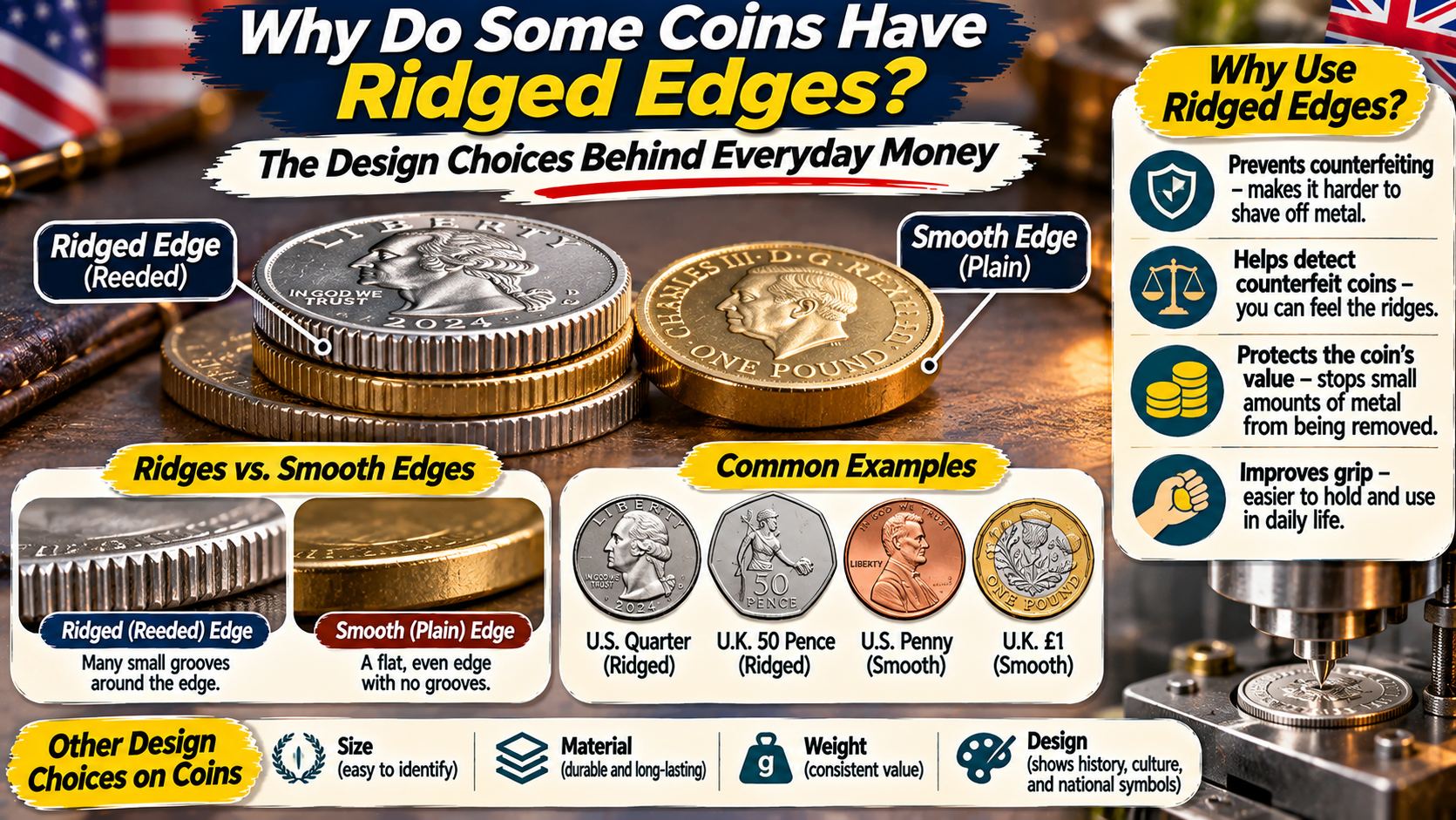
If the collar die has smooth interior walls, it produces a plain edge; if the collar is vertically grooved, the lateral expansion of metal forces the planchet into the grooves, creating the crisp reeded edge (milled edge) found on American dimes, quarters, and half dollars. Reeded edges were originally invented by Sir Isaac Newton during his tenure as Master of the Royal Mint in 1699 to combat the rampant crime of ‘coin clipping’—the fraudulent practice of shaving thin slivers of precious silver from the circumference of smooth-edged coins before spending them at full face value. If a coin possessed crisp reeded grooves around its edge, any fraudulent clipping was instantly visible.
In the contemporary twenty-first century mint, traditional plaster models and Janvier reducing lathes are increasingly supplemented by high-resolution 3D CAD sculpting software (such as ZBrush and FreeForm), optical laser surface scanners, and direct-to-die femtosecond laser ablation machines capable of cutting microscopic holographic textures directly into steel. Yet despite these revolutionary digital tools, the foundational soul of coin design remains unchanged: a timeless marriage of fine artistic sculpture, deep metallurgy, and extreme mechanical physics, transforming raw industrial metal into the miniature artistic monuments of sovereign nations.
Key Takeaways: Coin Die Engraving Mechanics
Bas-Relief Compression: Engravers must compress life-sized three-dimensional sculptures into low reliefs under 0.35 mm with draft angles to prevent dies from seizing.
The Janvier Pantograph: The 1899 reducing lathe used a tracing ruby and carbide cutter to mathematically shrink large galvano models into miniature master steel dies.
The Tooling Pyramid: Mints squeeze master dies into master hubs and working dies, preserving the original artist sculpture across millions of production strikes.
Coining Press Physics: Presses deliver up to 180 tons of hydraulic force at 800 strikes per minute, forcing softened metal to flow into die cavities and reeded collar rings.