Typographic Enigma: The Global Sovereign Glyph
The dollar sign ($) is arguably the most potent and universally recognized financial symbol on Earth. Emblazoned across global stock tickers, software code, commercial billboards, and pop culture, its exact origins have sparked fiery debates among paleographers, historians, and numismatists for over two centuries.
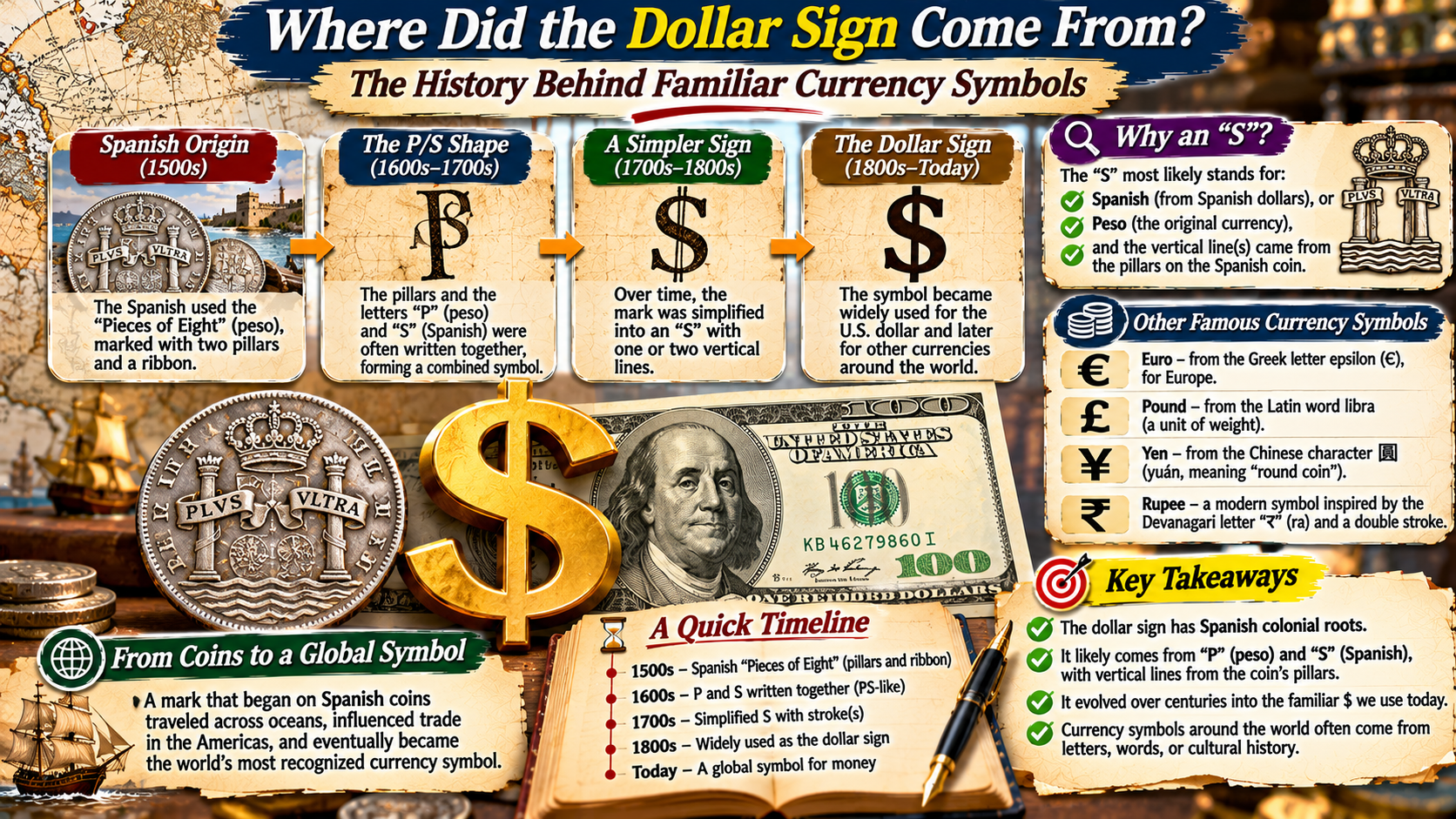
Contrary to popular myths asserting it originated as an overlapping ‘U’ and ‘S’ monogram or a mystical Masonic emblem, exhaustive archival research demonstrates that the dollar glyph evolved directly from handwritten commercial ledger abbreviations for the Spanish-American silver Peso—the legendary ‘Piece of Eight’ that fueled the American Revolution.
🪙
Part I: Myth Busting
Debunking the Monograms: Myth Versus Paleographic Evidence
Before examining the authentic historical and numismatic trajectory of the dollar sign, one must rigorously dismantle the persistent folkloric myths that crowd popular culture. The most pervasive myth—frequently championed by political philosophers like Ayn Rand in her novel Atlas Shrugged—asserts that the dollar sign was intentionally invented by early American patriots as a patriotic monogram combining the capital letters ‘U’ and ‘S’ (standing for United States). According to this folklore, the curved bottom of the ‘U’ was laid over the capital ‘S’, and when the bottom curved loop of the ‘U’ was dropped for typing speed, it left an ‘S’ intersected by two vertical bars ($).
While poetically appealing to American national pride, this monogram theory is a historical impossibility. Thorough archival examination of colonial ledgers, merchant diaries, and diplomatic correspondence in the United States National Archives confirms that the dollar sign with both single and double vertical strokes was actively in use years before the Declaration of Independence in 1776, and decades before the country officially designated itself the ‘United States of America’. An identical chronological impossibility refutes the theory that the symbol represents the initials of Uncle Sam—a folkloric character who did not emerge in American political cartoons until the War of 1812.
Other esoteric theories connect the glyph to the Roman sestertius (abbreviated in classical inscriptions as ‘IIS’ or ‘HS’, representing two and a half asses, where two vertical tally strokes were bound by a horizontal bar), or to religious iconography such as the brazen serpent of Moses wrapped around a cross staff. While intriguing, paleographers reject these theories because currency symbols do not materialize from ancient mystical retrospection; they evolve through rapid, repetitive cursive handwriting shortcuts executed by thousands of pragmatic merchants, sea captains, and treasury clerks balancing daily financial ledgers.
| Theory / Hypothesis | Proposed Symbolic Derivation | Historical Plausibility | Archival Evidence Status | Scholarly Consensus Verdict |
|---|---|---|---|---|
| Spanish Peso Abbreviation (ps) | Cursive merchant slurring of ‘p’ and ‘s’ into a single overlaid glyph ($) | Extremely High (Documented) | Found in hundreds of 18th-century merchant ledgers (e.g., Oliver Pollock, 1778) | Universally accepted by modern paleographers & historians |
| Pillars of Hercules & Ribbon | Twin vertical columns of Gibraltar entwined with imperial banner on Spanish coins | High (Visual & Cultural) | Directly depicted on millions of circulating Spanish Columnarios (1732–1772) | Strong secondary iconographic influence reinforcing double-stroke $ |
| United States Monogram (U+S) | Superimposition of capital ‘U’ and ‘S’ representing the new republic | Zero (Chronologically Impossible) | Dollar symbol appears in ledgers decades before ‘United States’ existed | Completely debunked 19th-century patriotic folklore |
| Potosí Mintmark Monogram | Overlapping letters P-T-S-I stamped on silver cobs minted in Bolivia | Moderate (Geographical Plausibility) | Potosí monogram was ubiquitous on colonial silver bullion throughout the Americas | Likely contributed to visual familiarity, but secondary to cursive ‘ps’ |
| Roman Sestertius (IIS / HS) | Ancient Roman accounting abbreviation for two and a half bronze asses | Extremely Low | No continuity of use across medieval European or colonial American trade | Superficial visual coincidence without documentary lineage |
⚖️
Part II: The Real de a Ocho
The Spanish Real de a Ocho: The King of Colonial Currencies
To trace the genuine ancestry of the dollar sign, one must understand that during the seventeenth and eighteenth centuries, the American colonies suffered from a chronic, paralyzing shortage of British sterling coinage. The British Crown, enforcing mercantilist imperial trade policies, strictly prohibited the export of official gold sovereigns and silver shillings to the American colonies, compelling colonial merchants to settle debts in agricultural commodities (such as barrels of tobacco, bushels of wheat, or beaver pelts) or acquire foreign silver through illicit Caribbean and Atlantic maritime trade.
The dominant foreign coin circulating throughout the thirteen colonies—and indeed across the entire Atlantic commercial world—was the Spanish silver eight-real coin: the Real de a Ocho, universally known in the English-speaking world as the Spanish Milled Dollar, the ‘Piece of Eight’, or simply the Peso (from peso de ocho, meaning ‘weight of eight’). Minted in vast industrial quantities in the silver-rich viceroyalties of Mexico City, Potosí (Bolivia), and Lima (Peru), the Piece of Eight was struck on high-purity silver planchets (approximately 90.3 percent fine, weighing 27 grams), establishing it as the most trusted, liquid bullion currency on Earth.
British colonists adopted the term ‘dollar’ as their vernacular English name for the Spanish eight-real piece. The word itself was a linguistic corruption of ‘thaler’—an abbreviation of Joachimsthaler, a famous high-grade sixteenth-century silver coin minted in the valley of Saint Joachim (Joachimsthal) in the Kingdom of Bohemia. Because the Spanish eight-real coin was identical in weight and fineness to the German thaler, English merchants naturally referred to the Spanish piece as the ‘Spanish Dollar’. When the Continental Congress under George Washington and Alexander Hamilton authorized funding for the Continental Army, they denominated their military debts and revolutionary paper currency not in British pounds, but in Spanish Milled Dollars.
🏛️
Part III: The Archival Breakthrough
The Oliver Pollock Breakthrough: Archival Proof in Revolutionary Ledgers
The definitive documentary breakthrough regarding the graphic origin of the dollar sign was achieved in the early twentieth century by the distinguished monetary historian Professor Florian Cajori of the University of California, Berkeley. Conducting an exhaustive forensic examination of thousands of handwritten commercial manuscripts, bill books, and colonial diplomatic archives dating from the eighteenth century, Cajori traced the precise cursive transformation that birthed the symbol.
In Spanish colonial accounting books, the plural form of the word ‘peso’ was routinely abbreviated as ‘ps’. In English commercial ledgers kept by transatlantic merchants trading with Spanish colonies, quantities of Spanish dollars were similarly entered by writing ‘p’ followed by an elevated superscript ‘s’ (pˢ). Because merchants entered thousands of ledger lines per day, rapid cursive script caused the letters to merge: the pen began writing the vertical stem of the ‘p’, looped around the bowl, and immediately swung upward to form the ‘s’ directly over the vertical descender. Over time, the loop of the ‘p’ was compressed, leaving the vertical line cutting directly through the center of the ‘s’—producing the modern dollar sign ($).
The earliest documented, undeniable appearance of the dollar symbol in surviving historical archives was penned by Oliver Pollock—an Irish-born merchant, international trader, and patriot financier of the American Revolution based in Spanish New Orleans. Pollock served as the commercial agent of the Continental Congress in Louisiana, securing vast loans of gunpowder, rifles, uniforms, and Spanish silver dollars from the Spanish Governor Bernardo de Gálvez to finance General George Rogers Clark’s military campaigns in the Illinois territory. In a handwritten ledger dated April 30, 1778, preserved in the United States National Archives, Pollock repeatedly wrote the modern single-stroke dollar symbol ($) alongside financial figures in his accounts with Robert Morris, the Superintendent of Finance for the Continental Congress. Morris adopted Pollock’s symbol in his official treasury correspondence, cementing the glyph into the administrative DNA of the fledgling American government.
👑
Part IV: The Columnarios
The Pillars of Hercules: The Architectural Twin-Stroke Hypothesis
While the cursive contraction of ‘ps’ explains the single-stroke dollar sign ($), what accounts for the widespread traditional variant featuring two vertical parallel strokes through the ‘S’? For this, numismatists point to the magnificent physical design of the Spanish Columnarios (Pillar Dollars) struck between 1732 and 1772 at the royal mints of Mexico City, Lima, and Santiago. The reverse of these famous coins depicted the two crowned hemispheres of the Old and New Worlds resting upon ocean waves, flanked on either side by two monumental classical columns representing the Pillars of Hercules (the ancient Strait of Gibraltar).
In classical Greek mythology, the Pillars of Hercules bore the Latin warning Ne Plus Ultra (‘Nothing Further Beyond’), denoting the absolute western boundary of the known world. However, following the voyage of Christopher Columbus and the discovery of the Americas, King Charles V of Spain famously altered the motto to Plus Ultra (‘Further Beyond’), celebrating Spanish maritime dominion across the Atlantic. On the Pillar Dollar, each column was wrapped in a curling, ribbon-like scroll inscribed with the words PLUS on the left pillar and ULTRA on the right. Visually, the vertical stone pillar wrapped in an S-shaped banner forms an unmistakable graphic depiction of an ‘S’ entwined around a vertical column.
Colonial Americans handled millions of these Pillar Dollars daily. In visual culture and popular merchant iconography, the twin Pillars of Hercules entwined with ribbons were widely recognized as the sovereign insignia of Spanish silver wealth. When merchants drew the double-stroke dollar sign, the twin vertical lines directly evoked the twin Pillars of Hercules, providing a powerful secondary visual reinforcement that coalesced with Oliver Pollock’s cursive ‘ps’ abbreviation to produce the enduring twin-stroke dollar glyph.
📜
Part V: Print Revolution
The Potosí Monogram and the Transition to Mechanical Typography
An additional, potent numismatic contributor to the dollar sign’s visual familiarity was the royal mintmark monogram of the Imperial Mint of Potosí in Alto Perú (modern-day Bolivia). Home to the legendary Cerro Rico (‘Rich Mountain’)—the largest deposit of silver in human history—Potosí operated one of the most prolific mints in the Spanish Empire. From the late sixteenth century onward, coins and refined silver bars cast at Potosí were officially stamped with an intricate monogram that superimposed all the letters of the city’s name into a single device: the capital letter ‘P’ interlinked with ‘T’, ‘S’, and ‘I’. Viewed at a glance, the Potosí mintmark forms an ‘S’ wrapped around a central vertical stem, virtually indistinguishable from a modern dollar sign.
The crucial transition of the dollar sign from handwritten ledgers into permanent mechanical typography occurred in the late 1790s. In 1797, a Philadelphia publisher named Archibald Binny and punch-cutter James Ronaldson established the first permanent type foundry in the United States. Recognizing the universal adoption of the symbol in commercial accounting, Binny and Ronaldson cast the first mechanical metal type font featuring the dollar symbol ($) in 1797, releasing it in their landmark specimen book. The symbol was quickly adopted by newspapers, broadsheets, and accounting manuals across the nation.
When the United States Coinage Act of April 2, 1792, established the United States Mint in Philadelphia, it officially codified the dollar as the national monetary unit of account, explicitly defining its value as matching the exact silver content of the Spanish Milled Dollar (371.25 grains of pure silver). The symbol ($) was rapidly exported across global shipping networks as American trade expanded, eventually being adopted by dozens of sovereign nations for their own dollar-denominated currencies (including Canada, Australia, New Zealand, Singapore, and Hong Kong), alongside nations in Latin America that retained the symbol for their national pesos. Today, the dollar glyph stands as a monumental cultural bridge: an enduring typographic masterpiece that connects modern global digital markets directly to the Spanish galleons, silver mines, and revolutionary ledgers of the eighteenth century.
Key Takeaways: The Dollar Sign ($)
Paleographic Reality: The dollar symbol evolved from the cursive Spanish merchant abbreviation ‘ps’ (pesos), where the ‘p’ and ‘s’ merged into a single vertical stroke over an ‘S’.
The Oliver Pollock Milestone: The earliest documented usage appears in an April 1778 ledger by revolutionary financier Oliver Pollock in correspondence with Robert Morris.
The Pillar Dollar Influence: The double-stroke variant ($) reflects the visual iconography of the Spanish Columnarios, where the Pillars of Hercules are entwined with curling banners.
The 1797 Typographic Leap: Cast into metal print by Philadelphia founders Binny and Ronaldson, the glyph transitioned from handwritten ledgers into the global universal symbol of finance.
The Global Proliferation of the Dollar Sign Across International Currencies
The worldwide dominance of the dollar sign ($) accelerated dramatically throughout the nineteenth and twentieth centuries as developing sovereign nations sought to align their commercial institutions with the booming trade economies of the Americas. In Latin America, newly independent republics emerging from the collapse of the Spanish Empire—including Mexico, Argentina, Chile, Colombia, and Uruguay—retained the historic Peso as their national monetary unit and naturally preserved the traditional ‘$’ glyph as their national currency symbol, where it remains in official use to this day.
Across the Pacific and Atlantic, the British Commonwealth witnessed widespread transitions away from the cumbersome £sd pounds-and-shillings system in favor of decimal dollars. Canada adopted the Canadian dollar ($ / CAD) in 1858, Australia launched the decimal Australian dollar ($ / AUD) in 1966, New Zealand adopted the New Zealand dollar ($ / NZD) in 1967, and Singapore and Hong Kong codified the Singapore dollar ($ / SGD) and Hong Kong dollar ($ / HKD) as major Asian financial center currencies. Each of these sovereign nations adopted the ‘$’ symbol, creating a global linguistic network where the glyph became the universal shorthand for market liquidity, enterprise, and sovereign purchasing power.